Friday, 22 February 2019

STRAIT JACKET


d. William Castle (1964)

There is a sub-genre of cinema known as Psycho Biddy. You may already know that, but I think it’s worth reiterating as it always gives me a little pang of pleasure. A Psycho Biddy film contains a middle aged (or older) woman who is either guilty or suspected of suffering from a violent mental illness. Murder and mayhem most usually follows. Sometimes the biddy turns out NOT to be a psycho, and it is instead the people and world around her that are insane. Either ways, these films tend to be an amusing blend of over the top melodrama and gruesome physical and psychological horror, and are recommended as long as you don't mind screaming, lots and lots of screaming.
The psycho biddy here is domestic nightmare Joan Crawford. The film starts with her hacking her unfaithful husband and his floosie to death with an axe then flashes forward twenty years to her release from the asylum. The timid, aged, very grey Joan moves in with her now grown up daughter (who witnessed the whole thing) and, slowly, begins to regain a little of her mojo thanks to a new wardrobe and a polyester wig. Just when she begins to think her nightmare is behind her, she starts hearing voices and hallucinating severed heads. Then the decapitations begin…
It's a very William Castle type of William Castle film, in that the majority of the artistry in this film went into the title and the casting, and the rest just hangs loosely on the (hopefully wood, not wire) hanger. There is the odd visual flourish, and Joan has fun playing on the periphery of hysteria and it's nice to see persistent b-movie menace George Kennedy get his (paper mache) noggin knocked off. It's good fun.

Castle saves the best joke for the last frame, a reconstruction of the famous Columbia pictures logo of the flag draped lady carrying a torch. In Castle's version, her head has been chopped off, and sits neatly at her feet.

Friday, 15 February 2019

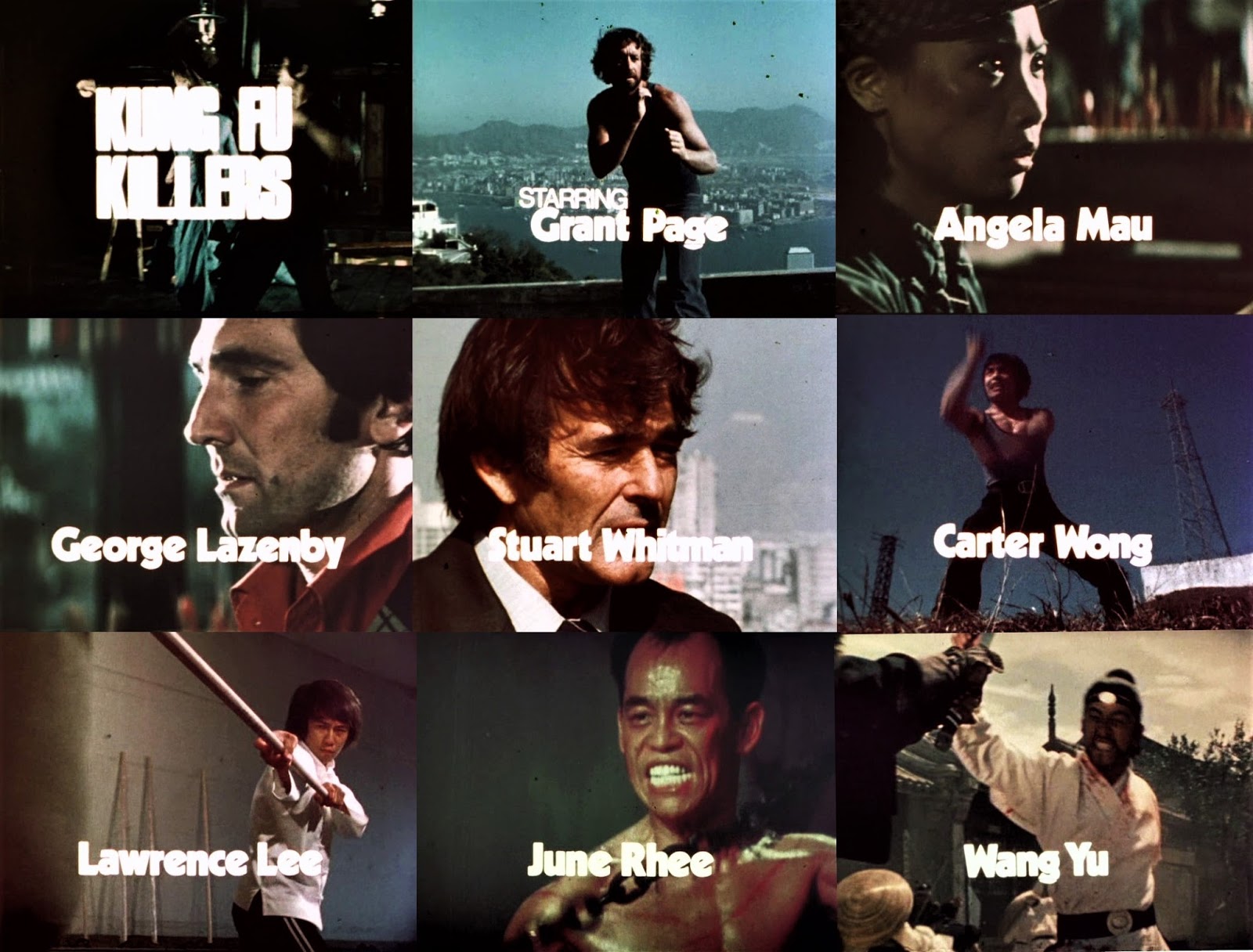
KUNG FU KILLERS


d. Brian Trenchard-Smith (1974)


It’s difficult for today people to comprehend just how big Kung Fu was back in the 1970s. Previously seen as an ancient, esoteric, slightly shifty thing that foreigners did, the phenomenal success of Enter the Dragon turned the rabid consumers and novelty seekers of the West onto all arts martial, including karate style pyjamas which my brother and I plagued our parents for and then wore to chop and high kick the shit out of each other. 

I can remember being ill in 1974 with whooping cough, sat out on a blanket in the back garden (it was the Summer, not some extreme form of quarantine) and reading a big pile of Marvel comics, every single one of which featured either a black or Asian protagonist absolutely expert in martial arts. Later on, my Mum called me in to watch Hong Kong Phooey. Man, those were literally the days, being approximately twenty four hour periods of solar rotation that have now passed.

Australia, being a mere 3,500 miles from Hong Kong, was naturally very excited by the Kung Fu boom, and this documentary fronted by a hairy stuntman and climber called Grant Page profiles some of the stars of the genre, including inexplicably pleased with himself countryman George Lazenby and the indefatigable American star Stuart Whitman, already nearly 25 years into his career and looking smooth and in control, qualities he would use to sinister effect in his role as the Reverend Jim Jones in the 1979 film Guyana: Crime of the Century.   

Both men are obviously excited by the trend, not least, I suspect, because it pays them the sort of money that they can no longer command in Hollywood. When Lazenby, a self-proclaimed free soul and searcher of truth, is asked what he has learned so far he smirks and says 'beware of the Chinese'. And why not? As the arrogant occidental narrator states: 'they are not just a nation of waiters'.

Stuntman Page is not a particularly engaging or knowledgeable interviewer, but he does get into a fight – twice – with martial arts star Carter Wong, something that Michael Parkinson never did, unless you count his tussle with Emu (I don’t). Page spends some time showing off to semi-naked women in Bottoms Up, 'an upper class topless bar' if that isn't a moronic oxymoron. He also spends a lot of screen time equating martial arts to his own sport, climbing, pointing out that he uses a lot of the same muscles and has iron will power, etc. What do you expect from someone who wears a vest instead of a shirt?  

Ultimately, we don’t learn a massive amount about how to attain 'strength, peace of mind, and a love of life through the apparent study of violence' but it's an interesting period piece, full of frenetically action packed film clips of people being kicked in the face. We also see the bit from Game of Death where Bruce Lee tears out a fistful of Chuck Norris' chest hair, a spectacle I never, ever, ever tire of watching. 

Friday, 8 February 2019

STONER


d. Huang Feng (1974)
 
Originally planned as a $10m international blockbuster starring Bruce Lee, Sonny Chiba and George Lazenby, The Shrine of Ultimate Bliss was understandably compromised by Lee’s sudden death, which left a huge superstar shaped void (and no longer guaranteed box office success) and prompted the enigmatic Chiba to pack his samurai sword and go back to Japan. Rapidly regrouping, the supremely practical producer Raymond Chow slashed the budget by 9/10ths and had the ambitious script hastily rewritten to accommodate its remaining star, rangy Australian Lazenby, the man who walked out on the James Bond franchise claiming he didn’t need the degradation and could make more money elsewhere (his sole outing, 1969's On Her Majesty’s Secret Service once  underrated, is now vastly overrated. Objective reality: it’s not bad).

The end result, renamed Stoner in a number of territories to further emphasise the centrality of Lazenby’s character, is a shaggy but exhilarating mix of crime, espionage and crunching kung fu, centring around the invention, distribution and use of a new drug called Happy Pills, an opium based aphrodisiac and mind blower that has flooded the far east causing instant addiction and is now threatening places where white people live. After the drug related death of his sister, the moustachioed and slightly detestable Joshua Stoner decides to investigate, striding through the temples, night clubs and back alleys of Hong Kong in an incredibly conspicuous way, not least because he is at least a foot taller than everybody else.

Lazenby is as much tailors dummy as actor, but he does exhibit what he brought to his uneven interpretation of Bond, a sudden, brutal physicality that manifests itself in a number of fast, bruising and very convincing fight scenes. He’s no Bruce Lee, of course, but he hands out (and takes) a number of comprehensive beatings, and looks committed and convincing as he does so, aided and abetted by crunching and slapping noises dubbed loudly over the action.

He later teams up with a Taiwanese undercover cop played by the rather marvellous Angela Mao, part mouse, part lion, and the last half of the film plays out like a Bond film: they infiltrate the billionaire villain’s underground lair (he doesn’t have a white cat, instead, rather curiously, he has a spinning desk), then kill him in an interesting and grisly way and blow everything up. The End.

Additional highlights include the discordant electronics that play when anyone mentions drugs, Stoner’s taupe and caramel wardrobe and cloak clad Rupert, a deep voiced, statuesque black love guru who leads a flaky hippy sex cult made up of really scrawny white blokes and a number of dirty faced women who greedily and obscenely suck ice lollies when the Happy Pills start to kick in.  

Friday, 1 February 2019

THE WEREWOLF


d. Fred F. Sears (1956)

Cheaply but carefully made, The Werewolf provides a surprisingly contemporary retelling of the hoary old lycanthropic legend, placing the action in Smalltown USA and making it a condition of mad modern science rather than arcane folklore.

The origins of the werewolf are somewhat odd, with responsibility falling to a couple of fascist scientists who plan to outlive the impending nuclear apocalypse by combining human genes with the survival traits of other successful species. When a timid salesman injured in a car crash falls unexpectedly into their clutches they ruthlessly inject him with a syringe full of lupine essence and sit back ready to note down the results.

Their victim escapes, of course, and trudges through the snow to the small ski resort town of Mountaincrest. Here, the poor, frightened fellow transforms into a ravenous, drooling wolf: a hairy, hungry killing machine. The townspeople, dressed almost exclusively in plaid, form a posse to track him down.

The werewolf spends most of his time running, but never really gets anywhere, not least because there’s nowhere to go. In his old life he was a nice man with a wife and a son but now he is a crazed killer, a beast who inadvertently seals his fate by ripping apart the scientists who made him like this in the first place. With literally no turning back, he ends up full of yokel bullets, a bloodied heap of hair. His dying act is to revert to his human form, a pitiful and questioning look upon his face. 

It’s rather a depressing spectacle, but then werewolf films never have happy endings, they just don’t work that way.

Friday, 25 January 2019

THE CYCLOPS


d. Bert I. Gordon (1957)

A group of pushy Americans looking for a lost pilot crash land in a mysterious Mexican valley. The trip has been organised by the pilot's girlfriend who, even after three years, can't accept that he is dead. On the plus side, the valley is filled with million of dollars of raw uranium; on the down side, it's inhabited by a  menagerie of enormous creatures, many times their normal size: lizards, insects, rats, eagles, snakes and, most memorably, a twenty five foot tall nappy wearing man beast with one eye, terrible teeth and a partially melted face. Is he friendly? Not so much. Could he conceivably hold the secret to the mystery of the missing man? I wonder... 

I particularly like the scenes of the Cyclops menacing people. Lacking depth perception, he rather struggles to grab them, so we're just left with a poorly back projected hairy hand jabbing pointlessly at the actors (at one point accidentally tearing away the backdrop). The cast, which includes Lon Chaney, Jr. as a loveable dirtbag, don't seem to quite know what they are reacting to and their blank, confused faces combine with poorly executed special effects to provide a very silly 64 minutes.

The Cyclops, who (of course, it's so obvious now!) turns out to be the missing pilot, ends up being speared in his remaining eye and left to die. It's rather cruel: he didn't ask to be marooned in that radiation choked valley and get mutated into a horrible giant, after all. His once devoted girlfriend, having quickly realised the drawbacks of being involved with an ugly, angry monster, is in the arms of another man before her massive ex-beau has even fallen over and died.    

Director, writer and producer Bert I. Gordon ('Mr. B.I.G') obviously liked the concept (and the make up) revisiting it in both The Amazing Colossal Man (1957) and its sequel War Of The Colossal Beast (1958), although in these films the mutation is the result of plutonium bomb testing.    

Friday, 18 January 2019

THE BRAIN EATERS


d. Bruno VeSota (1958)

'A few weeks ago, Riverdale, Illinois was just another small, quiet town. But on that Saturday just after midnight, a living nightmare began'.

A 200 million year old race of hungry neon leeches land on on Earth with the idea that they are going to plug themselves in to the necks of human beings, operate them like mad puppets until they finish eating their brains, and then move on until the supply is extinguished. You can see what's in it for the leeches, but the Midwest natives are unconvinced, so eventually use science, a harpoon gun and several lives to zap the little bleeders into oblivion.

Not much happens, to be honest, but it's relatively well made and the alien's ship, a gleaming metallic cone of unknown material filled with a myriad of concentric tunnels, is interesting, as is the late appearance of the human manifestation of the malevolent hirundea, happily played by our old friend Leonard Nemoy (that's how it's spelled on the credits), wearing a silly Father Christmas beard to make him look older and wiser, his familiar features further obscured by odd lighting and a vaseline smeared lens. It's good to sort of see him.

Friday, 11 January 2019

THE MUMMY'S GHOST


d. Reginald Le Borg (1944)

‘If the Mummy didn’t make these tracks, I’ll eat ‘em’
It’s shit being a Mummy.  Dead, but not dead, wrapped in putrid rags that reek of your own decay. One eyed, one armed, one foot dragging awkwardly behind. You can’t speak, you can’t reason and, with no will of your own, you are wide open to become the shuffling slave of any unscrupulous person who knows the evocations and boils the right number of Tana leaves during a full moon.  Your heart, that putrefying organ, is filled with ancient spores and moss and dirt but, cruelly, still functions just well enough for you to continue to suffer the acute pain of a centuries dead lost love. 

And what do you do when you’re not needed to kill, to kidnap, to terrorise, to steal artefacts? Where do you go, what space do you inhabit? Do you live under a bridge, like a bandage wreathed troll? Or do you just sit in a shed or a cave or in the heart of the woods and wait? After all, waiting is second nature to you – actually, its first nature, the thing that you are most familiar with after thousands of years of stasis.  

Then, when you find that your beloved Princess Ananka has been reincarnated, how do you plight your troth? You lumber up to the poor girl and scare her into unconsciousness, terrify her to the extent that a grey streak spontaneously appears in her hair: she isn't pleased to see you, and that feeling of deathless love over the millennia is most definitely not mutual. 

So, you scoop up her inert body and drag her off to the river like so much laundry, pursued by an angry mob and a scrappy little dog who hates your dusty guts. As you disappear into the muddy water, dragging your (now inexplicably aged) reincarnated Princess with you, what do you think you’ll find down there? Peace? Contentment? Rest? These things are not available to you. They never will be. You'll be back.

It’s shit being a Mummy.