Showing posts with label Monsters. Show all posts

Friday, 9 April 2021

HAND OF DEATH


d. Gene Nelson (1962)

Dr. Alex Marsh (schlock superstar John Agar, Shirley Temple's first husband) is one of those madly intense scientists obsessed with making the world a better place by inventing unspeakable things. 

The main thrust of his work is to combine a hypnotic drug and non-deadly nerve gas, thereby giving the U.S.A a paralyzed and compliant enemy to invade. His reasoning is that it will save the horror and destruction of nuclear war but, as he speaks, his eyes glitter and his mouth grows wet: the idea excites him very much, a lot more than his over-eager fiancee seems to, who is reduced to playing the coquette with his cheerful best friend in desperate lieu of attention from her permanently working husband to be. 
 
One late night, an exhausted Marsh clumsily spills some of his experimental solution over his hands, and tears open his lab coat and Hawaiian shirt in pain and horror before falling onto the bed and hallucinating test tubes, beakers and scurrying white mice. When he awakens, he not only has a first class tan, but the merest touch of his hands means instant death, a lesson his Mexican lab assistant learns very quickly. Ever responsible, Marsh douses the corpse and the rest of the lab in white spirit and puts a match to it before driving off to cause chaos downtown.

A film that runs out of steam very quickly and soon descends into jumbled images of a bloke just staggering about, Hand of Death is most notable for Marsh's transformation from handsome(ish) young(ish) scientist to bloated, blackened monster, as mutation turns his head into a lump of swollen coal and his deadly hands into bunches of over-ripe bananas. 

Interestingly, to disguise the disfiguring condition that has distorted his entire body and robbed him of his speech and sanity, he does the only thing he can under the circumstances: he puts a hat on.  

Friday, 8 January 2021

CAPTIVE WILD WOMAN


d. Edward Dmytryk (1943)

Noted endocrinologist John Carradine has made the familiar transition from dedicated scientist to unhinged maniac. He steals a friendly gorilla from a circus and implants it with the glands of his nurse, who made the mistake of suggesting that he was probably working too hard. The result, somewhat improbably, is a beautiful, exotic looking woman who he names Paula Dupree (she's played by Acquanetta, 'the Venezualan Volcano', actually born in Wyoming).

Because he's mad and drunk on his own cleverness, the doctor takes his creation back to the circus, where it becomes clear that Paula has a miraculous power over animals: they are shit scared of her. She is immediately enlisted as an assistant to the big cat tamer, her main role being to stand outside the cage in a spangly outfit just looking intently at the lions and tigers*. Occasionally, if they become unruly, she will look harder, perhaps arching an eyebrow. It's nice work if you can get it, though, presumably, there isn't a massive amount of demand for that sort of talent.

Falling in love with the big cat tamer sends powerful emotions coursing through her reconfigured body, however, breaking her new glands and unleashing her inner gorilla. By the time she is shot by an over zealous cop (nothing much changes in America) she has fully reverted to her old, hairy animal self, but there is a moment roughly halfway between her initial retro-transformation from human lady to ape woman to gorilla in which she is probably the most beautiful thing I have ever seen.

* These scenes feature Clyde Beatty, the world famous animal trainer. It is amazing to watch him face down a dozen snarling big cats, but his methods leave a lot to be desired. There is also a lot of footage of lions and tigers fighting each other, an incredible but unedifying spectacle. 

Friday, 1 January 2021

DAUGHTER OF DR JEKYLL


d. Edgar G. Ulmer (1957)

As you might expect from the title, this is a silly sort of film, albeit one that seems to wilfully muddle horror mythology simply for the sake of it. It's also a film that is occasionally hard to watch, as the interiors and exteriors are so unevenly matched in terms of quality and visibility that they might as well be from completely different productions.

When a young woman turns 21, she inherits a large country estate and the truth about her lineage: she is the daughter of the notorious Dr. Henry Jekyll. Despite the fact that she was born several years before he started the experiments that would transform him into Mr. Hyde, she is frightened that his 'condition' might be hereditary, concerns that her guardian is rather poor at assuaging: 'Well, there's absolutely no proof that it is - and absolutely no proof that it isn't'. The condition in question, by the way, is Lycanthropy. Yes, sod Robert Louis Stevenson, Dr. Jekyll was, it seems, a werewolf. Don't worry, though, the local villagers know what to do to stop a 'blood sucking' werewolf. That's right, you bang a stake through its heart*. 

Despite being under sedation and locked in her room, every night Ms. Jekyll has feverish dreams of herself as a saturnine, feral figure, emerging from the family crypt to kill. When she wakes up she is in her own bed, but covered in blood and mud to find that, invariably, another female servant has been murdered on her way back home to the village. 

The set up of these murders is less than meticulous, and it is soon apparent that it is physically impossible for Ms. Jekyll to have committed them. All we're seemingly left with is the prospect of a Scooby Doo big reveal type ending - which, happily, doesn't quite happen, as there is one more left handed twist of the cinematic pepper pot which, along with a superbly eerie theremin score,  just about redeems the whole thing.

Staking werewolves, though? Come on.  

* As a lifelong horror enthusiast, this actually hurt my feelings.

Friday, 11 December 2020

MAN BEAST


d. Jerry Warren (1956)

My expectations were low for this film, so I was pleasantly surprised to find myself watching lots of (generally well filmed) footage of a small group of people traipsing through snow and climbing mountains hunting for the Abominable Snowman, especially as, every now and again, a scruffy looking Yeti would appear from behind a rock or from a hole in the ice to watch their progress and shake his manky head at the folly of it all. Then, towards the end of the film, when a sinister mountain guide ripped open his silk chemise to reveal a coarsely matted white hairy chest, declaiming that he was part Yeti himself, I choked on my can of Lilt and ascended into psychotronic heaven powered by the sheer silly brilliance of it all.  

It seems that the Yeti are simultaneously at several stages of evolution. Some look like albino gorillas with skulls for faces (they mainly do the heavy work); some are more man than beast, facilitated by a breeding programme with kidnapped local women. The sinister mountain guide is particularly excited about getting his hands on the sole female in the expedition, an American woman, as he believes that their offspring would perhaps skip two generations of development, maybe putting a Yeti in the White House by the year 2,000.

Triple threat film maker Jerry Warren is often criticised for the sheer shoddiness of much of his output, but, on this evidence, he could also put something half way decent together when he wanted to. Man Beast is cheap, yes, but it is also fun, engaging, surprising and the mountain footage is nicely done. Sure, it's no La Regle du jeu, but then I've always thought the highly rated French classic conspicuously lacking in Yeti action.       

Friday, 4 December 2020

NIGHT OF THE LEPUS


d. William F. Claxton (1972)

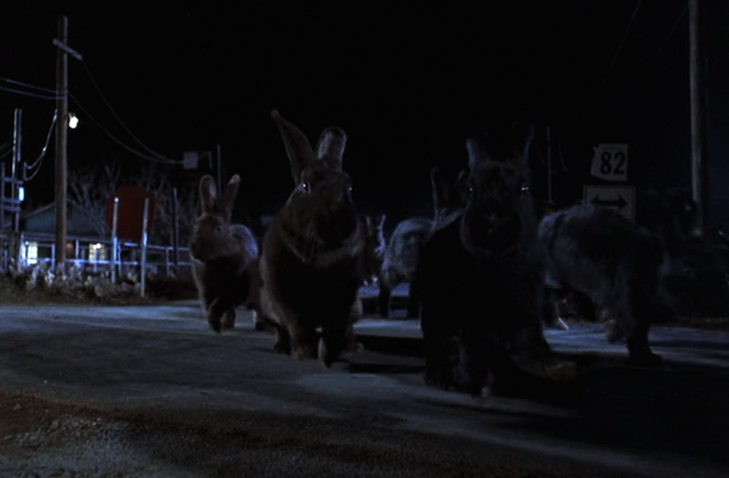
Everybody knows that rabbits aren't scary or threatening, no matter how massive they are or how much ketchup you smear around their mouths and adorable twitching noses.This simple fact, seemingly ignored by all involved in this farcical production, completely destroys any scintilla of authenticity from the opening shot onwards. After 90 minutes, as we watch hundreds upon hundreds of giant rabbits shot to bits and electrocuted, we don't feel any relief that a scruffy piece of American desert and a few hillbillies have been saved, we just feel desperately sad for the slaughter and a little bit dirty, like Sir Stanley Baker at the end of Zulu.

The overgrown 'lepus' haven't been created by 'bad' science in this instance - their rapid growth, rampant aggression and unexpected liking for human meat is actually the result of humane, experimental work to inhibit their breeding and save them from a total cull. Put that in your irony pipe and puff it, PETA. The test tube work is done by an idealistic 'young couple' Stuart Whitman and Janet Leigh (both in their mid forties but looking much older) but is inadvertently compromised by their young daughter, who can't resist playing with the fluffy specimens and accidentally mixes up the test subjects - with preposterous results.  

This small but pivotal role was originally earmarked for the teenage Jamie Lee Curtis, until Mum Janet vetoed it: she didn't want her little girl anywhere near a horror film.

Anyway, if you do have a rabbit, go and stroke it. Other pets / euphemisms may very well apply.  

Friday, 18 September 2020

THE GIANT CLAW


d. Fred F. Sears (1957)

The Giant Claw is surprisingly considered for a film about a massive killer bird from outer space which looks like a cross between a new born vulture and Rod Hull's Emu. The enormous (and enormously goofy looking) winged monster is, in fact, from a galaxy many millions of light years away, a galaxy made of anti-matter. As such, the Giant Claw (for the record, it has several giant claws) is impervious to our weapons and so flaps around the world quite freely, destroying planes and trains and cars as if they were simply slightly shabby scale models, knocking the tops off buildings and chomping down pedestrians and parachutists like screaming fleshy tic tacs.  

It takes a lot of collateral damage and a great deal of convoluted sort of science chat before the forces of humanity are able to blast the creature out of the skies for good, although, before hand, and to their great satisfaction, they do manage to find its nest and scramble its huge solitary egg with a couple of sniper rifles.

This film went by so quickly it almost felt like a dream, just not as realistic. It works very well on its own terms and the super-sized death turkey with its mohican hair-do (or is it a wind blown comb across?) and tombstone teeth is a once seen, never forgotten creation.

Friday, 11 September 2020

BLOOD FREAK


d. Brad F. Grinter (1972)

We've all seen cautionary tales about the dangers of drug consumption, and those of us who like our films psychotronic will have seen our fair share of movies about the transformative powers of mad and unsanctioned science. Blood Freak manages to combine these two hot topics to present us with the far out story of a narcotics fiend who turns into a turkey.

Hunky Herschell is just back from Vietnam, with only a badly burned arm and a dope habit to show for his tour of duty. While riding from town to town on his chopper, he meets up with Angel, a Bible spouting dolly bird who, despite her obvious moral rectitude, takes him to a hippy drug party and introduces him to her wilder and more switched on sister, Ann. Sultry Ann sets her cap at the upright, uptight Herschell, and conspires with her sleazy drug dealer to get her target to smoke an instantly addictive joint, after which he falls into bed with her.

Herschell gets a job at the local poultry farm where, for extra cash, he chows down on turkey that has been illegally experimented upon. Soon afterwards he has a seizure and, when he wakes up, he is surprised to find (as are we) that he has the big, gnarled head of a turkey cock and major collywobbles from drug comedown. Actual turkey, cold turkey: it’s a very clever metaphor. Doubly damned, he now creeps about grabbing addicts and slitting their throats, drinking their dope rich blood like coca cola while his supposedly dead victims cough and splutter as the strawberry syrup goes into their eyes and up their noses. 

This madness is interspersed with sardonic commentary from director, Brad F. Grinter, a permanently smoking grizzled guy who has clearly lived hard and well and reads his erudite words from an offscreen piece of paper, perhaps due to short term memory loss. Grinter concludes this outrageous story by saying that it is 'partly based on fact, partly based on probability', clearly bullshit. In the end analysis, though, this is a film about a vampire turkey that manages to entertain without a knowing nod, a wink or an arched eyebrow, so it's pretty much beyond normal criticism as far as I'm concerned. 

Friday, 4 September 2020

OCTAMAN


d. Harry Essex (1971)

Octaman isn't a very good film in any respect, but it has a massive amount of chutzpah, not least in its ambition to make a feature length movie with virtually no budget and hardly any script. Half of what money there was must have gone on two past their best name actors: former Gulliver, Sinbad and Jack the Giant Killer, Kerwin Matthews, and Italian erstwhile ingenue Pier Angeli, who would accidentally overdose on barbiturates shortly after the production wrapped (I say ‘accidentally’, but perhaps she was trying to avoid attending the premiere).

The rest of the cash was obviously spent on the Octaman rubber suit, because we see it from every angle - and it looks pretty good: two legs, six tentacles and a dome shaped head, fiery red eyes and a hideous toothy hole for a mouth, a perennially open 'o' that looks a bit like Paul McCartney's mouth, or a cats arse.  We don’t see any obvious zips or a visible pant line (common monster costume mistakes) but we can see that the suit is in two parts, the bottom half of which is the world’s craziest and leggiest pair of green slacks.

As in most monster films, the Octaman wants revenge on the humans who have encroached on his land and ruined it (as you might surmise from the existence of a massive, land walking octopus, Octaman has been mutated by industrial pollution) but here they have also stolen two of his kids, one of which died in a bucket en route to the lab, with the other dissected alive by a local 'scientist' (he doesn't even wash his hands). What follows is a cat and mouse chase, assuming the cat is a bloke in a rubber suit who moves very, very slowly and the mice are idiots who do everything they can to continually blunder into the cat's flailing tentacles. 


Lives are lost, lives are saved, guns are cocked, shots are fired. There's a subplot about a failing circus and the two main characters are a sweet couple, middle aged people engaged to each other. After what seems like a long time, Octaman is finally shot enough to disappear back into the toxic water with an ignominious plop. Often, films like these try to finish on an ambiguous note or perhaps set the scene for a sequel, but here 'The End' appears before the ripples have even subsided, no question mark, no ellipsis, that's the end of that.

Friday, 17 April 2020

THE MAZE


d. William Cameron Menzies  (1953)

Sir Gerald MacTeam (Richard Carlson) doesn’t have any trace of a Scottish (or even recognisably British) accent, even though he is heir to a Baronetcy and a large, gloomy castle in the Highlands. When he receives an urgent telegram (is there any other type?) he drops everything (including his pretty fiancée) to hurry  home – and doesn’t come back. After a few weeks, his wife in waiting and her Aunt decide to investigate, only to find themselves embroiled in a terrifying world of shadows, secrets and slime.

You can tell that The Maze was originally shown in 3D by the sheer amount of things that get shoved towards the viewer: the animate (a lithe lady dancer); the inanimate (a telegram), and the somewhere in-between (a rubber bat on a piece of string). Like the rest of the film, however, this is all window dressing for the genuinely surprising finale, in which an enormous frog looms into three dimensional view before throwing itself out of a window.
This shock climax is concluded with a long scene in which the Sir Gerald tells us what the hell just happened. I’m not going to give it away but it involves Teratology, i.e. abnormal development. At first his explanation sounds absolutely ridiculous but, because he perseveres with it, his story ultimately achieves some degree of pathos, if not verisimilitude. It’s still absolutely ridiculous, though*.  

* Director William Cameron Menzies isn't at his best here, unfortunately: perhaps he was still thinking about his other 3D film of 1953, the extraordinary anti-Communist fever dream Invaders From Mars.

Friday, 13 March 2020

SHE DEMONS


d. Richard E. Cuhna (1958)

She Demons is a pulp magazine brought to life, you know, the sort with a cover that has a statuesque blonde in her scanties being tortured by a Nazi with a lascivious expression on his face.  Chuck in a hurricane, some horribly scarred women, a live volcano, some mild bondage, lots of flagellation and a bongo number and you have any number of reasons to enjoy this fun little feature that was clearly made on a shoestring and in someone’s back garden but, nevertheless, is stupidly entertaining.

Irish McKenna plays the statuesque blonde, a spoiled little rich kid who finds herself stranded on an uncharted desert island after her Daddy’s yacht sinks in a hurricane (she admonishes her rescuer for not salvaging the essentials: ‘you might at least have picked me up a pair of toreador pants’). The island, as you might expect, is populated by a savage she cult of mutated women and a gang of nasty Nazis, led by a scientist who is trying to restore his wife’s lost beauty (some lava fell on her face) by experimenting on the natives. It’s a bad scene, especially when the head German takes a shine to Irish and decides that SHE will be his Queen from now on.
Totally preposterous, extremely enjoyable, She Demons is some sort of classic, and comes highly recommended for anyone with an interest in sensation, shock science and interpretive dance - which has got to be everybody, surely? 

Friday, 20 December 2019

THE CAPE CANAVERAL MONSTERS


d. Phil Tucker (1960)

For all its power and wealth and air punching bravado, America is a frightened country: scared of infiltration, scared of domination, scared of difference, scared of dissent, scared of being unable to follow the manifest destiny invented to give them the excuse to do whatever they want. In The Cape Canaveral Monsters the Americans come up against aliens who share this self-centred obsession, but rather impudently have a manifest destiny of their own: to own and rule Earth.

The aliens take the form of hyperactive balls of light whose jittery movements are accompanied by discordant, disorienting music. They have the ability to live in human corpses, and live in human corpses they do, starting their invasion by causing a fatal car crash and casually moving into the male and female victims. Both are hideously disfigured, and the male corpse has his arm ripped off, but the aliens reason that they're not entering any beauty contests and there are lots of spare arms out there and, besides, the bloke alien can always stick his clearly not missing arm down the side of his trousers and hope for the best.  

Their mission is to disrupt missile tests at Cape Canaveral using some sort of magnetic ray gun. Whatever it is, it works. The idea is to destabilise the space programme and prepare the way for an alien invasion. Only a sex obsessed young scientist and his put upon girlfriend can save the Earth and after 70 minutes of fairly uneventful narrative, they do. It ends on an ambiguous note, so the Americans stay scared and angry, their default position. 

Not a bad film, but that doesn't make it a good one. It's okay, and I'm okay with that and so should you be.       

Friday, 25 October 2019

SPACE AMOEBA


d. Ishiro Honda (1970)

Japanese monster movies are a little like sushi: they look great and they are lots of fun, but they’re not exactly what you might call filling. Nevertheless, like sushi, I enjoy them very much. I like the rubbery monsters, the comical mugging, the stock characters. I like the way that the films only really come to life when the monsters are on the screen, and only really catch fire when you have one or more fighting and smashing things up.

The Space Amoeba in question attaches itself to an unmanned space probe, which crashes into the sea near a desert island, one of the many isolated atolls in the archipelago of greater Japan. The amoeba resembles an electrical current, or a neon sneeze, and attaches itself to living organisms, taking control of their minds and greatly increasing their size and aggression levels. Over the course of the story we see a giant cuttlefish (erroneously described as an octopus), two giant crabs and a giant turtle. They are all angry and like the taste of human beings, particularly the wriggling, screaming ones.

The amoeba clearly has its red beady eye on world domination but is somewhat thwarted by its inability to conquer a small island populated only by a superstitious native tribe and a half dozen city slickers with guns, grenades and lots of petrol. Eventually, it takes over a human being, who gains super strength and a maniacal glow. In the version I watched, this character is dubbed by an Australian, which is slightly confusing for a Japanese man but not a disaster. The problem is that, along with his chin beard, black glasses, white safari suit and constant chuckling to himself, the Aussie twang only accentuates his resemblance to Rolf fucking Harris. Happily, he throws himself into a live volcano when his humanity briefly returns. Maybe Rolf could go and do the same.  

Friday, 18 October 2019

THE MANSTER


d. George Breakston and Kenneth G. Crane (1962)

Regular readers may have noticed that many of the films written about here are concerned with transformation, mainly of the uncontrolled and uncontrollable sort: people shrink or grow; they die but stay alive; they become bestial and unhinged or taken over, mostly at the gnarled hands of bad science, pure evil or alien conquest. Is that the worst thing, do you think? To become other, to turn into someone or something that you can't manage, and to know it is happening, to feel yourself slipping further and further into the void. Is it a metaphor for the human condition? Does transformation evoke old age, illness, death? Yes, in these films transformation is death, and can only be cured by more death including, ultimately, your own. I need some Propranolol.

In The Manster, jaded US foreign correspondent Larry Stanford is on his last assignment in Japan when he meets genius geneticist, Dr. Suzuki. Suzuki is interested in 'the beginnings of life' and seems nice enough despite keeping his brother and wife in the basement, having turned them into a hairy white ape and a disfigured hag respectively. While Larry has a Mickey Finn induced nap, Suzuki injects him in the neck with a serum designed to turn the hapless journalist into an entirely new life form.

In time honoured fashion, the first Larry knows about it is when he notices he has a very hairy hand. Next, he is startled to discover an eyeball embedded in his shoulder. After a few out of character homicidal rampages, an additional head emerges from him, malevolent and wizened, resembling a fairground coconut with comedy teeth. Head two is murderously angry with everything and everybody, not least Larry, who he wants to get away from as quickly as possible, ultimately leading to a violent split between host and parasite. 

As Larry reverts to human form, his erstwhile spare head and body conveniently having fallen into a live volcano, there is barely a second to wonder if Larry will pay for his crimes before the film's abrupt end. Let's hope the Japanese police are prepared to blame it all on the psychopathic man monkey and let Larry go home.  

Friday, 3 May 2019

FROM HELL IT CAME


d. Dan Milner (1957)

The image of some creature lumbering out of the woods or jungle to threaten us is a primal fear, a reminder perhaps of harder, wilder times. No wonder that it features in so much of our folklore and mythology and, of course, our films. Where would our films be without screaming girls clutched in the horrible hands of hideous creatures? Nowhere, that’s where.

From Hell It Came is a South Sea Islands variation on the theme, and here the monster is the Tabanga, a malevolent tree stump. The film makers hedge (no pun intended) their bets a little by giving the grim faced tree multiple origins, and it is variously described as a mythical monster, a murdered Prince returning from the grave to exact revenge and a direct result of nuclear testing, but all of that is just incidental detail. What matters most is that the Tabanga is remarkably angry for flora, and immediately sets out on a murderous rampage.

The killer tree is notable for its permanent scowl, its indiscriminate and versatile approach to violence, and for the fact that it resembles something that they might put in a kids playground at a Halloween themed Wetherspoons. It eventually ends up in ‘the quicksand at the edge of the jungle’, a fairly predictable conclusion given that everyone in the cast says ‘the quicksand at the edge of the jungle’ at least once, just in case we miss the fact that it’s there. One primal fear down, 35,000 to go*.

* An arbitrary number, as thinking of primal fears was starting to freak me out. 

Friday, 1 February 2019

THE WEREWOLF


d. Fred F. Sears (1956)

Cheaply but carefully made, The Werewolf provides a surprisingly contemporary retelling of the hoary old lycanthropic legend, placing the action in Smalltown USA and making it a condition of mad modern science rather than arcane folklore.

The origins of the werewolf are somewhat odd, with responsibility falling to a couple of fascist scientists who plan to outlive the impending nuclear apocalypse by combining human genes with the survival traits of other successful species. When a timid salesman injured in a car crash falls unexpectedly into their clutches they ruthlessly inject him with a syringe full of lupine essence and sit back ready to note down the results.

Their victim escapes, of course, and trudges through the snow to the small ski resort town of Mountaincrest. Here, the poor, frightened fellow transforms into a ravenous, drooling wolf: a hairy, hungry killing machine. The townspeople, dressed almost exclusively in plaid, form a posse to track him down.

The werewolf spends most of his time running, but never really gets anywhere, not least because there’s nowhere to go. In his old life he was a nice man with a wife and a son but now he is a crazed killer, a beast who inadvertently seals his fate by ripping apart the scientists who made him like this in the first place. With literally no turning back, he ends up full of yokel bullets, a bloodied heap of hair. His dying act is to revert to his human form, a pitiful and questioning look upon his face. 

It’s rather a depressing spectacle, but then werewolf films never have happy endings, they just don’t work that way.

Friday, 25 January 2019

THE CYCLOPS


d. Bert I. Gordon (1957)

A group of pushy Americans looking for a lost pilot crash land in a mysterious Mexican valley. The trip has been organised by the pilot's girlfriend who, even after three years, can't accept that he is dead. On the plus side, the valley is filled with million of dollars of raw uranium; on the down side, it's inhabited by a  menagerie of enormous creatures, many times their normal size: lizards, insects, rats, eagles, snakes and, most memorably, a twenty five foot tall nappy wearing man beast with one eye, terrible teeth and a partially melted face. Is he friendly? Not so much. Could he conceivably hold the secret to the mystery of the missing man? I wonder... 

I particularly like the scenes of the Cyclops menacing people. Lacking depth perception, he rather struggles to grab them, so we're just left with a poorly back projected hairy hand jabbing pointlessly at the actors (at one point accidentally tearing away the backdrop). The cast, which includes Lon Chaney, Jr. as a loveable dirtbag, don't seem to quite know what they are reacting to and their blank, confused faces combine with poorly executed special effects to provide a very silly 64 minutes.

The Cyclops, who (of course, it's so obvious now!) turns out to be the missing pilot, ends up being speared in his remaining eye and left to die. It's rather cruel: he didn't ask to be marooned in that radiation choked valley and get mutated into a horrible giant, after all. His once devoted girlfriend, having quickly realised the drawbacks of being involved with an ugly, angry monster, is in the arms of another man before her massive ex-beau has even fallen over and died.    

Director, writer and producer Bert I. Gordon ('Mr. B.I.G') obviously liked the concept (and the make up) revisiting it in both The Amazing Colossal Man (1957) and its sequel War Of The Colossal Beast (1958), although in these films the mutation is the result of plutonium bomb testing.