Showing posts with label Horror. Show all posts

Friday, 26 March 2021

INCUBUS


d. Leslie Stevens (1966)

In a village by the sea, the venal and the conceited gather to prolong their worthless lives with the magical, recuperative powers of the local water. Whilst there, they are seduced by succubi: young, blond women who lead them into temptation and then kill them and send their corrupted souls to Satan.

Into this rather odd set up walks William Shatner - a wounded soldier with an incorruptible soul. When a succubi cannot destroy a man, she is fated to fall in love with him - with far reaching cosmic results.

Thrown together quickly by 'Outer Limits' producer Leslie Stevens, 'Incubus' is a truly bizarre film: arty, beautiful, original - yet also clumsy and cheap and very slow moving. It looks like a Bergmanesque bad dream, and the choice of Esperanto as the language spoken throughout is a stroke of strange genius* - it makes an odd film even odder, and lends a suitably disorienting feel to this already atmospheric production.

A few words about William Shatner: I love him, and his presence in something is always a treat. I don't care about his hair and he's always been a good enough actor for me. We'll miss him when he's gone.

* The actors apparently speak it very badly, though, so the film isn’t even a favourite with Esperanto speakers.

Friday, 19 March 2021

HANDS OF A STRANGER


d. Newt Arnold (1962)

A noir-ish take on the much filmed Hands Of Orlac, this is a torrid tale of a self-obsessed concert pianist called Vernon Paris who has his hands mangled to buggery in a car crash. He is treated by an equally egocentric surgeon, who takes the decision to illegally graft the hands of a victim of a gangland slaying onto Paris’ bloodied stumps. The operation is a complete success, if you don’t count the bit where Rose goes insane and starts killing people, first by mistake, later by design. Oh, and afterwards he plays the piano like a chimp at a tea party, so that didn’t work either.

This is a terrifically entertaining film, filled with intense performances and clever but florid dialogue which goes a mile a minute and would probably call a spade a hand operated metal and wood earth penetrating excavation device. It’s also choc-a-bloc with clever camera work and punchy visual motifs, mostly hands and pianos and hands playing pianos. Everything is played in deadly earnest and without a scintilla of camp, which, of course, makes it all ten times better (and ten times camper).
Unlike the Orlac story, we never find out who the transplant hands belong to, so there is little emphasis on the hands as being evil or imbued with evil, although it does make you wonder why they spent the time establishing that the donor was a gangster if they weren’t going to use that as part of the story. Here, the supernatural is replaced by the practical, the psychological: put simply, the accident and transplant snap Paris’ already brittle mind, and drive him to kill over and over again (he breaks his victims fingers, then strangles them). This ripe exchange sort of marks the boundaries:

'If you're concerned with the possibility that the donor might have been some kind of madman, let me assure you that psychotic tendencies don't transfer themselves to the physical extremities after death!'

'You know that for a fact?'


'No, no, I don't!'


Need I say any more? Recommended.

Friday, 15 January 2021

DEATH BY INVITATION


d. Ken Friedman (1971)

If you’re looking for pace and excitement, then this film is not for you. Languid to the point of being in a stupor, the story concerns a reincarnated witch, Lise (Shelby Levington, excellent), who, three hundred years after her execution in Salem, is able to wreak her revenge on the descendants of her chief persecutor in modern day Staten Island.

Lise is attractive, intelligent, nonchalant, cool and sexy as hell. She starts by insinuating herself into the family as a trusted friend, before callously killing the family’s teenage son, and suspending his dismembered corpse in a plastic bag in a cupboard. She then decapitates their teenage daughter and ‘helps’ their six year old girl fall down the stairs to her death. All the while she wears black and pulls sympathetic faces, supporting the family through their grief as she plans her next diabolical move, building up to taking out the patriarch, a bumptious, arrogant drunk who just happens to look exactly like the man who killed her all those centuries ago.

Lise is not really a witch by deed: she doesn’t cast any spells or hop about in the nude invoking the goat of Mendes or Gaia or whoever or whatever witches invoke. In fact, there is no evidence that she ever sticks a pin in anything. Lise is a witch by character, full of strength, resolve, defiance. Her mission is about revenge, pure and simple, executed with strength and cold, relentless intent.

Right at the beginning of the film, Lise tells the nerdy, doomed teenage son a long story about a primitive tribe where women were the leaders and the hunters and the men merely acolytes and hand servants. When the women were challenged by an alpha male, they pursued him through the woods and, when they caught up with the upstart, tore him apart with their hands and teeth for his impudence. It’s a mesmerising monologue, performed well, and lets us know that she can’t stop, won’t stop in her mission, despite the fact that, with the exception of the father, who is a real piece of work, the rest of her victims seem ordinary, totally harmless, certainly undeserving of death and misery and loss on the scale inflicted upon them. Their niceness is irrelevant, however, Lise wants her pound of flesh, and isn’t bothered about how she balances the scales.

A slow but quietly immersive film, reeking of comedown and 1971, that only loses points towards the end by having Lise fall for a guy who bullies her into loving him and thus diminishes her powers and her will to kill. As if.

Friday, 8 January 2021

CAPTIVE WILD WOMAN


d. Edward Dmytryk (1943)

Noted endocrinologist John Carradine has made the familiar transition from dedicated scientist to unhinged maniac. He steals a friendly gorilla from a circus and implants it with the glands of his nurse, who made the mistake of suggesting that he was probably working too hard. The result, somewhat improbably, is a beautiful, exotic looking woman who he names Paula Dupree (she's played by Acquanetta, 'the Venezualan Volcano', actually born in Wyoming).

Because he's mad and drunk on his own cleverness, the doctor takes his creation back to the circus, where it becomes clear that Paula has a miraculous power over animals: they are shit scared of her. She is immediately enlisted as an assistant to the big cat tamer, her main role being to stand outside the cage in a spangly outfit just looking intently at the lions and tigers*. Occasionally, if they become unruly, she will look harder, perhaps arching an eyebrow. It's nice work if you can get it, though, presumably, there isn't a massive amount of demand for that sort of talent.

Falling in love with the big cat tamer sends powerful emotions coursing through her reconfigured body, however, breaking her new glands and unleashing her inner gorilla. By the time she is shot by an over zealous cop (nothing much changes in America) she has fully reverted to her old, hairy animal self, but there is a moment roughly halfway between her initial retro-transformation from human lady to ape woman to gorilla in which she is probably the most beautiful thing I have ever seen.

* These scenes feature Clyde Beatty, the world famous animal trainer. It is amazing to watch him face down a dozen snarling big cats, but his methods leave a lot to be desired. There is also a lot of footage of lions and tigers fighting each other, an incredible but unedifying spectacle. 

Friday, 1 January 2021

DAUGHTER OF DR JEKYLL


d. Edgar G. Ulmer (1957)

As you might expect from the title, this is a silly sort of film, albeit one that seems to wilfully muddle horror mythology simply for the sake of it. It's also a film that is occasionally hard to watch, as the interiors and exteriors are so unevenly matched in terms of quality and visibility that they might as well be from completely different productions.

When a young woman turns 21, she inherits a large country estate and the truth about her lineage: she is the daughter of the notorious Dr. Henry Jekyll. Despite the fact that she was born several years before he started the experiments that would transform him into Mr. Hyde, she is frightened that his 'condition' might be hereditary, concerns that her guardian is rather poor at assuaging: 'Well, there's absolutely no proof that it is - and absolutely no proof that it isn't'. The condition in question, by the way, is Lycanthropy. Yes, sod Robert Louis Stevenson, Dr. Jekyll was, it seems, a werewolf. Don't worry, though, the local villagers know what to do to stop a 'blood sucking' werewolf. That's right, you bang a stake through its heart*. 

Despite being under sedation and locked in her room, every night Ms. Jekyll has feverish dreams of herself as a saturnine, feral figure, emerging from the family crypt to kill. When she wakes up she is in her own bed, but covered in blood and mud to find that, invariably, another female servant has been murdered on her way back home to the village. 

The set up of these murders is less than meticulous, and it is soon apparent that it is physically impossible for Ms. Jekyll to have committed them. All we're seemingly left with is the prospect of a Scooby Doo big reveal type ending - which, happily, doesn't quite happen, as there is one more left handed twist of the cinematic pepper pot which, along with a superbly eerie theremin score,  just about redeems the whole thing.

Staking werewolves, though? Come on.  

* As a lifelong horror enthusiast, this actually hurt my feelings.

Friday, 4 December 2020

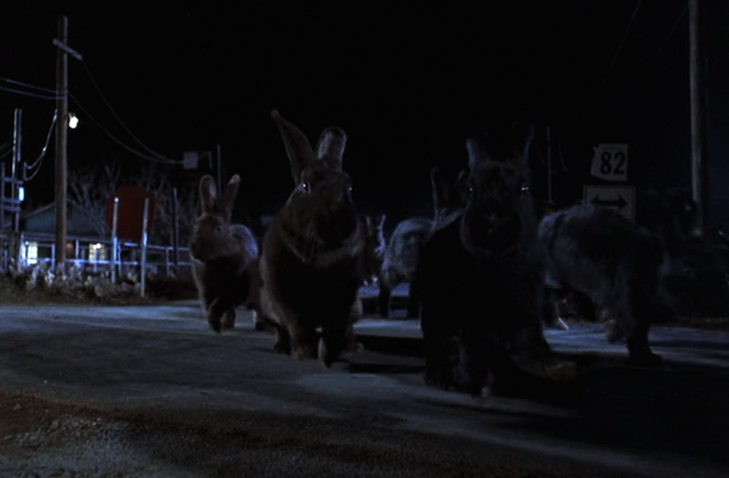
NIGHT OF THE LEPUS


d. William F. Claxton (1972)

Everybody knows that rabbits aren't scary or threatening, no matter how massive they are or how much ketchup you smear around their mouths and adorable twitching noses.This simple fact, seemingly ignored by all involved in this farcical production, completely destroys any scintilla of authenticity from the opening shot onwards. After 90 minutes, as we watch hundreds upon hundreds of giant rabbits shot to bits and electrocuted, we don't feel any relief that a scruffy piece of American desert and a few hillbillies have been saved, we just feel desperately sad for the slaughter and a little bit dirty, like Sir Stanley Baker at the end of Zulu.

The overgrown 'lepus' haven't been created by 'bad' science in this instance - their rapid growth, rampant aggression and unexpected liking for human meat is actually the result of humane, experimental work to inhibit their breeding and save them from a total cull. Put that in your irony pipe and puff it, PETA. The test tube work is done by an idealistic 'young couple' Stuart Whitman and Janet Leigh (both in their mid forties but looking much older) but is inadvertently compromised by their young daughter, who can't resist playing with the fluffy specimens and accidentally mixes up the test subjects - with preposterous results.  

This small but pivotal role was originally earmarked for the teenage Jamie Lee Curtis, until Mum Janet vetoed it: she didn't want her little girl anywhere near a horror film.

Anyway, if you do have a rabbit, go and stroke it. Other pets / euphemisms may very well apply.  

Friday, 13 November 2020

DEMENTIA 13


d. Francis Ford Coppola (1963)

A rather murky tale of intrigue and murder set in Ireland, the plot revolves around that most baleful of storylines, the death of a child and the terrible, dysfunctional, psychotic effect it has on an already eccentric (and not Irish in the slightest) family.

The young Francis Coppola wrote and directed the film, the culmination of a short apprenticeship with producer and director Roger Corman that had seen him doing anything and everything from editing, dubbing and script writing to the washing up and driving. Corman worked his interns pretty hard, but he was also remarkably astute about talent and very generous with opportunities. When 'The Young Racers' concluded under budget and ahead of schedule, Corman decided to maximise the saving by giving Coppola forty grand, nine days and Samuel Beckett's favourite actor* to make his very own film - as long as it was a bit like Psycho**.

The script (written more or less overnight) is, perhaps not unexpectedly, a little uneven, and the direction is occasionally self-conscious but, overall, it's an impressive achievement, not least because of the atmosphere of sustained dread it creates and some nicely realised underwater shots. There's also a short monologue about a recurring nightmare and incipient madness that makes you stop everything that you're doing to listen to it, including breathing.

* I am referring, of course, to the amazing Patrick Magee, an actor with a sinister voice somewhere between a purr and a croak and an extraordinary intensity. I was going to describe him as immortal, but he died in 1982, and I thought somebody might write in.

** The opportunity turned out to be a parting gift: Corman hated the film, and Coppola went his own way after the test screening.

Friday, 30 October 2020

CURSE OF THE UNDEAD


d. Edward Dein (1959)

An uneven horror western, Curse Of The Undead isn't completely successful but it does come up with the brilliant idea of a vampire working as a hired gun, a black clad killer who isn't particularly quick on the draw because he doesn't have to be: you can shoot him all you like with ordinary bullets, it doesn't make a scrap of difference.

The vampire himself (played by Australian character actor Michael Pate) is almost sympathetic and, in his attacks on the necks of the local girls, regretful and tender. It seems that, some twenty years previously, he found out that his new wife had been sleeping with his brother, so he stabbed the brother to death before killing himself. Via a route that is not particularly well signposted, he then came back as a vampire and few soft necks have been safe since. To his credit, he hates what he has become, shouting 'do you think I wanted this?' as he kills. It's not all nibbling virgins and long lie ins, you know.   

Somehow the vampire ends up in a love triangle with a beautiful local land owner called Dolores and her pompous and overbearing preacher boyfriend (Eric Fleming*) and, as this is cowboy times, it can only end in a shoot out. Although you're rooting for the vampire, the preacher prevails, killing his undead rival with a holy bullet, a slug capped with a sliver of thorn from the site of the crucifixion. As the vampire's body fades away into nothingness, Dolores looks on in horror, knowing that this means she will now have to marry the boring, bossy Vicar and spend the rest of her life hearing about how he saved her life . Oh well, Dolores does mean 'sorrows', after all...


* I don't like Fleming's character in this film, but I always feel a bit sorry for the actor himself. In 1966, he was making a film in the Amazon when his boat overturned and he was eaten by piranhas. 

Friday, 11 September 2020

BLOOD FREAK


d. Brad F. Grinter (1972)

We've all seen cautionary tales about the dangers of drug consumption, and those of us who like our films psychotronic will have seen our fair share of movies about the transformative powers of mad and unsanctioned science. Blood Freak manages to combine these two hot topics to present us with the far out story of a narcotics fiend who turns into a turkey.

Hunky Herschell is just back from Vietnam, with only a badly burned arm and a dope habit to show for his tour of duty. While riding from town to town on his chopper, he meets up with Angel, a Bible spouting dolly bird who, despite her obvious moral rectitude, takes him to a hippy drug party and introduces him to her wilder and more switched on sister, Ann. Sultry Ann sets her cap at the upright, uptight Herschell, and conspires with her sleazy drug dealer to get her target to smoke an instantly addictive joint, after which he falls into bed with her.

Herschell gets a job at the local poultry farm where, for extra cash, he chows down on turkey that has been illegally experimented upon. Soon afterwards he has a seizure and, when he wakes up, he is surprised to find (as are we) that he has the big, gnarled head of a turkey cock and major collywobbles from drug comedown. Actual turkey, cold turkey: it’s a very clever metaphor. Doubly damned, he now creeps about grabbing addicts and slitting their throats, drinking their dope rich blood like coca cola while his supposedly dead victims cough and splutter as the strawberry syrup goes into their eyes and up their noses. 

This madness is interspersed with sardonic commentary from director, Brad F. Grinter, a permanently smoking grizzled guy who has clearly lived hard and well and reads his erudite words from an offscreen piece of paper, perhaps due to short term memory loss. Grinter concludes this outrageous story by saying that it is 'partly based on fact, partly based on probability', clearly bullshit. In the end analysis, though, this is a film about a vampire turkey that manages to entertain without a knowing nod, a wink or an arched eyebrow, so it's pretty much beyond normal criticism as far as I'm concerned. 

Friday, 14 August 2020

THE HYPNOTIC EYE


d. George Blair (1960)

The Hypnotic Eye is a hybrid film: part shock horror, part psycho thriller, part film noir. It’s also fairly nasty, being concerned with a series a horrible ‘accidents’ that befall young, beautiful women. In an arresting opening sequence, a pretty blonde happily shampoos her hair – over a gas stove.  The poor girl dies in the ensuing conflagration, the eleventh victim of who knows what, who knows who, and who knows why. The Police, as they so often are, are baffled.  
Completely coincidentally, the city is currently hosting a famous French hypnotist called Desmond, a man who can make anybody do anything just by flexing the power of his mind. Is there a connection between this suave mesmerist and a woman washing her face in sulphuric acid as if she believed it was soapy water? Or another drinking drain cleaner thinking it was coffee? And what, if anything, does his glamorous but permanently scowling assistant Justine have to do with it? You’ll just have to watch it and find out. Seriously, you should see it.

The most far out non-mutilation sequences are delivered in fabulous HypnoMagic. Not actually a cinematic variation on 3D as the poster might lead you to believe, but a dramatic style. Desmond’s act is mainly delivered direct to camera (by French actor Jacques Bergerac who is so good at it that it’s a shock to realise that he wasn’t really a hypnotist). It’s very effective and, apparently, in some cases led to some low level trance states amongst susceptible cinema goers. Don't worry, like all intelligent people I am immune to such psychic manipulation, although since watching this film I have started eating raw onions as if they were Granny Smiths.    

Friday, 7 August 2020

I DRINK YOUR BLOOD


d. David E. Durston (1970)

From the sensational title down, this fun and fast moving film is not what you’d call family viewing,  but the violence - a severed foot, a severed hand, a severed head - a stabbing where some guts falls out of the hole - is almost quaint, relying on unconvincing paper mache body parts and chunks of raw liver. Despite this, it has a reputation as a nasty film, perhaps because its main plot point is that a child injects meat pies with the dirty blood of a rabid dog in order to get his own back on the Satan worshipping hippies who raped his sister and made his granddad take LSD. That's the most unsavoury sentence I have ever written.

The Satan worshipping hippies are a multiracial Mansonesque group of scumbags who travel around backwoods America in a smelly black van stealing, squatting and spreading STDs. They’re despicable and cruel people who, in their desire to be utterly free, oppress everybody they come across, including  rats, which they hunt down and kill with great glee and sadistic violence. Under normal circumstances, I wouldn’t condone infecting anyone with a fatal disease but, in this case, they more than deserve it. Justice is a fickle thing, however, as the rabies doesn’t kill them straight away, instead turning them into dribbling kill and sex crazy zombie death bombs, staggering about biting people and spreading the infection like wildfire. Like all hippies, rabid or otherwise, they retain a great fear of running water, and this comes in handy for the few beleaguered residents that they haven’t managed to nibble on, include the ingenious lad who put the poison in the pie in the first place. Let’s hope somebody calls the army or, at the very least, the dog pound.   

Obviously cheap but well made, with some surprisingly good performances, I Drink Your Blood is trashy, and not exactly nice, but neither is it nasty, so pantomimic and gleeful is it in its mayhem and gore. I really enjoyed it, but then there’s something wrong with me. Fact.    

A special note about the film’s earthy synthesizer score, which is smeared all over and is completely off the chain. It was written and performed by Clay Pitts, who usually worked on Christian rock records and was clearly not a man afraid to diversify. Good work, Clay. 

Friday, 24 July 2020

THE MASK


d. Julian Roffman (1961)

Psychiatrist Allen Barnes has a patient who has stolen an ancient tribal mask from an University archive. It’s a chilling, horrible artefact, a crystalline skull with beady eyes and a hinged lantern jaw with jagged teeth, the sort of thing that looks like it should be encrusted in blood. The young man has become addicted to putting on the mask and experiencing an altered state, a sort of parallel dimension full of danger and horror. When he removes the mask, he feels the overwhelming urge to kill*.

Falling apart, the young man commits suicide, first posting the mask to Dr Barnes. Barnes, a rationalist and seeker of truth, cannot resist the temptation to put the mask on himself. What happens next is a form of Hell, as the psychiatrist sees the same terrible visions as his patient, undergoes the same ordeal, feels the same urges – and, almost instantly, begins to go completely insane.

A tremendous, supremely leftfield film, The Mask is good throughout but superlative in its four surreal 3D sequences. These nightmarish scenes have an extraordinary primal power: savage, pagan, occult, violent, disturbing and discombobulating. I've watched them with the glasses on and off and, actually, prefer the blurred reds and blues of the unprocessed image. The scenes are accompanied by the swoops and bleeps of an analogue electronic score and are absolutely outstanding, perhaps the best use of 3D ever.

On the film’s release, the audience were given a ‘magic, mystic mask’, a shaped set of 3D glasses. When a voice from the screen demanded ‘Put the mask on, NOW!’ they would don the glasses and enter the warped fantasy at the same time as the increasingly frazzled hero. My God, how I wish I’d been there.

* So many psychotronic films hinge on ‘the urge to kill’ that, in real life, the human race should technically have all been murdered long ago.  

Friday, 12 June 2020

TERRIFIED


d. Lew Landers (1963)

Pretty teenager Marge hasn't had much luck of late: her father was murdered by an unknown assailant; her mother was killed in a mysterious car crash, and her older brother was turned into a 'dribbling oyster' by a man in a black silk mask who threw him screaming into a grave at the local ghost town and then filled it with wet concrete until the boy's mind snapped at the prospect of being simultaneously drowned and buried alive. 

What Marge doesn't know is that the kinky killer is a man who is horribly fixated on her, and is systematically eliminating the people she loves in order to facilitate possessing her. This is also bad news for the two callow youths* who are wooing her, one of whom ends up being tormented and tortured and, yes, terrified to death.

It's pretty sick, especially at the climax when the unmasked killer says he first noticed Marge when she was ten years old, then whispers excitedly about her 'bare little feet' and 'torn dress' and promises to look after her always as she lies rigid with fear in his arms. At this point, my skin crawled off and hid behind the sofa.  

Terrified examines the notion of the cheerful small town where everything is gingham and gee willikers on the surface but, underneath, is sick and corrupt and rotten and dirty. It's a particularly American obsession: King's Row, Peyton Place and Twin Peaks all attest to that. America has a tragic, terrible history: a vast, wild, deadly landscape colonised by force, seeded by sacrifice, watered by blood, built on death. 

If the English are always bemoaning the fact that life used to be better, that the best of our country has come and gone, then perhaps the American psyche works in reverse, and the people are haunted by a folk memory of when things were infinitely worse. Is it any wonder that they are scared of what's out there in the dark?**

*  Technically only one callow youth: the other one is thirty three and looks every month of it, especially as he is painted, coloured and styled like a cheap whore in order to try and look 18.

**  According to the FBI, between 35 and 50 active serial killers at any one time, for a start.

Friday, 5 June 2020

THE CURSE OF THE FACELESS MAN


d. Edward L. Cahn (1958)

'Where's the dividing line between yesterday and today, between the past and the present, even between life and death?'  

Essentially a Mummy film, The Curse of the Faceless Man is, as you might expect, obsessed with death and forbidden love, reincarnation and revenge. Set in Italy, the monster here isn’t a long dead Egyptian swathed in bandages but rather an Etruscan gladiator contained in a carapace of volcanic ash, having been engulfed by the eruption of Vesuvius at Pompeii some two thousand years previously.

Discovered in a hole by an incredulous workman and taken to a museum in Naples, his scabby white body mostly lies around on its back with its arms and legs in the air, like a stunned beetle. At key moments, however, the ‘fantastic dead man’ drags himself to his feet and starts stomping stiffly around: ruthless, relentless, chopping people to death with the rock hard side of his horny hand.

Like most angry monsters, he’s all Id, operating purely on pre-set instructions. His mission is two-fold: to murder nominal authority figures like Policemen and Museum staff, and to be reunited with his lost love, who just so happens to have been reincarnated as a visiting American artist: an astonishingly fortuitous break for him, extremely bad luck for her.

It’s a shame that he is so preoccupied, really. Think of what he could have added to our knowledge of the ancient world if he hadn’t been a psychotic killing machine.

Friday, 29 May 2020

THE DARK


d. John Cardos (1979)

The original storyline for The Dark was fairly straightforward: an abused child is held prisoner in an attic until he reaches adulthood. When a house fire kills his abusers and sets him free he heads to the city and, completely unhinged, begins a brutal killing spree, averaging a murder a night and earning the nickname ‘The Mangler’. With the death count rising, it’s up to the Police, an investigative journalist, the father of a murdered girl and an eccentric psychic to find The Mangler and stop him in his tracks. It’s not exactly Shakespeare, but it works. Halfway through filming, having already fired director Tobe Hooper, the producers decided that aliens were the big thing, so The Mangler should be an alien, effectively throwing the film against the wall and letting it slide ignobly to the ground, bloodied and bent out of shape.

The alien looks like a werewolf or a make-up free Gene Simmons in a lumberjack outfit, a huge shambling thing with grey, putrid flesh. It possesses enormous strength, is impervious to bullets* and can fire lasers from its eyes, and, believe me, it fires lasers from its eyes a lot. It doesn’t like being set fire to but then, to be honest, who does?  In the end analysis, it’s an extremely crappy thing to ruin a film for, and what remains is a mass of non-sequiturs and undeveloped detail, with promising characters and situations cut off and cauterised in favour of expedient gimmickry that doesn’t make any kind of dramatic or cinematic sense.

As a final insult, the producers bookend the ruin with bullshit, firstly with a caption which pontificates about the certainty of life on other planets and that, like some nasty earth creatures, aliens might prove to be aggressive and deadly to man and, finally, with a concluding narration in a gravelly voice which states 'it was an encounter that has no explanation or understanding', i.e. 'Fuck knows what happened there. Right, see you later’. It’s extremely unsatisfactory, especially as it wastes a decent cast, a good cinematographer, Panavision, a $2m dollar budget and an unusual and interesting score** – this isn’t shoestring or amateur film-making, it’s just what happens when artless, greedy people are calling the shots.

*  I can understand how aliens might not be killed by a bullet, but this creature is literally shot a thousand times in the course of the final ten minutes. It’s clearly organic, so, at the very least,  wouldn’t bits of his body be torn apart, or severed? If nothing else, Wouldn’t the sheer weight of the bullets slow him down?

** In moments of tension, the soundtrack has a sibilant, insistent voice whispering ‘the dark-nessssssssssssss’.

Friday, 22 May 2020

THE RETURN OF DRACULA


d. Paul Landres (1958)

Count Dracula is a colossal failure when you think about it. He’s wealthy, charming, attractive; he can transform himself into a bat, a wolf, a rat, a fog and has the capacity to live forever. But he’s incompetent and arrogant, a fatal combination that means he is vulnerable to mortal men who have none of his advantages, but are simply sharper, smarter and more organised.

The Return of Dracula illustrates this perfectly. In an attempt to reboot the Dracula franchise for the drive in generation, Dracula comes to atom age California under the assumed identity of a man he murdered back in Transylvania. America was built on immigration, of course, and, under normal circumstances, would have provided Dracula with everything he needed to continue his career as a supernatural serial killer: lots of people, bags of space and plenty of opportunity. With a bit of planning he could spend eternity flitting from state to state, free from suspicion, safe from harm. Instead, he moves in with a suburban family, smashes all the mirrors and starts acting really suspiciously. Within a few hours he has bitten the family cat to death and, a couple of days later, he kills a woman who lives a few doors down. It’s just bad management. Why couldn’t he charm the community he is living in, establish a really good alibi and then fly over to another town to slake his inhuman thirst?

In a small town, of course, the arrival of a dark, surly foreigner followed by a sudden, unexplained death leads to some immediate dot joining so, within a few days he’s being pursued by the crucifix and stake wielding forces of good. Even then, he eschews the chance to put on his cape and move on, instead carrying on as indiscreetly as before. This hubris quickly turns him into a mouldering skeleton with a piece of sharp wood in his chest - again. 

He never learns, does he?

Friday, 17 April 2020

THE MAZE


d. William Cameron Menzies  (1953)

Sir Gerald MacTeam (Richard Carlson) doesn’t have any trace of a Scottish (or even recognisably British) accent, even though he is heir to a Baronetcy and a large, gloomy castle in the Highlands. When he receives an urgent telegram (is there any other type?) he drops everything (including his pretty fiancée) to hurry  home – and doesn’t come back. After a few weeks, his wife in waiting and her Aunt decide to investigate, only to find themselves embroiled in a terrifying world of shadows, secrets and slime.

You can tell that The Maze was originally shown in 3D by the sheer amount of things that get shoved towards the viewer: the animate (a lithe lady dancer); the inanimate (a telegram), and the somewhere in-between (a rubber bat on a piece of string). Like the rest of the film, however, this is all window dressing for the genuinely surprising finale, in which an enormous frog looms into three dimensional view before throwing itself out of a window.
This shock climax is concluded with a long scene in which the Sir Gerald tells us what the hell just happened. I’m not going to give it away but it involves Teratology, i.e. abnormal development. At first his explanation sounds absolutely ridiculous but, because he perseveres with it, his story ultimately achieves some degree of pathos, if not verisimilitude. It’s still absolutely ridiculous, though*.  

* Director William Cameron Menzies isn't at his best here, unfortunately: perhaps he was still thinking about his other 3D film of 1953, the extraordinary anti-Communist fever dream Invaders From Mars.

Friday, 13 March 2020

SHE DEMONS


d. Richard E. Cuhna (1958)

She Demons is a pulp magazine brought to life, you know, the sort with a cover that has a statuesque blonde in her scanties being tortured by a Nazi with a lascivious expression on his face.  Chuck in a hurricane, some horribly scarred women, a live volcano, some mild bondage, lots of flagellation and a bongo number and you have any number of reasons to enjoy this fun little feature that was clearly made on a shoestring and in someone’s back garden but, nevertheless, is stupidly entertaining.

Irish McKenna plays the statuesque blonde, a spoiled little rich kid who finds herself stranded on an uncharted desert island after her Daddy’s yacht sinks in a hurricane (she admonishes her rescuer for not salvaging the essentials: ‘you might at least have picked me up a pair of toreador pants’). The island, as you might expect, is populated by a savage she cult of mutated women and a gang of nasty Nazis, led by a scientist who is trying to restore his wife’s lost beauty (some lava fell on her face) by experimenting on the natives. It’s a bad scene, especially when the head German takes a shine to Irish and decides that SHE will be his Queen from now on.
Totally preposterous, extremely enjoyable, She Demons is some sort of classic, and comes highly recommended for anyone with an interest in sensation, shock science and interpretive dance - which has got to be everybody, surely? 

Friday, 31 January 2020

TORMENTED


d. Bert I. Gordon (1960)

Craggy middle aged Tom Stewart (craggy middle aged Richard Carlson) has it all: a beautiful young fiancée, a great career playing somewhat prosaic jazz piano, a cool pad, tight swimming trunks. The only insect in his unguent is Vi (Julie Reding), an old flame who loves him so much she’s prepared to wreck his life. Vi is pretty attractive in all sorts of ways (most of them sexual), and is quite obviously a bad lot as it's 1960 and her dress is so low cut that we can see her brassiere and several acres of her extensive bosom.  
They meet, as secret ex-lovers do, at the top of an abandoned lighthouse. It’s poorly maintained (bloody Council!), so a section of the guard rail gives way and leaves Vi hanging precariously over the raging sea. Stewart doesn’t kill her, but neither does he help her and so she falls screaming to her death: end of problem; start of story.

From here on in, despite being dead, Vi makes an awful nuisance of herself. Her ghostly footprints appear in the sand, bits of her jewellery keeping washing ashore, she covers her rivals wedding dress in seaweed and steals her engagement ring, and her disembodied head keeps appearing to Stewart to conduct increasingly bitter arguments with him. Some of these beyond the grave shenanigans are seen by others, some are not, so it’s hard to tell what is supernatural and what is psychological, whatever the difference is, although, either way, Stewart unravels pretty quickly.
In any event, by the end of the film an unhinged Stewart has killed a blackmailing beatnik (the great Joseph Turkel, one of Kubrick’s favourite actors) and is just about to murder a seven year old girl when Vi’s ghost swoops in and pushes him from the top of the lighthouse. The Council should have fixed that guard rail, or at least put some tape across the gap.

In a memorable coda, rescuers pull both Stewart's and Vi’s bodies from the sea and place them next to each other on the beach. Vi’s dead arm somehow flops onto Stewart’s corpse, revealing the stolen ring on her hand. It’s going to be a very long engagement.  

Thursday, 16 January 2020

THE CRAWLING HAND


d. Herbert L. Strock (1963)

The Crawling Hand is a low budget film which uses the space race to colour a fairly traditional horror story. In it, a moon shoot ends in disaster when, on the return journey,  the rocket goes haywire. Despite having run out of oxygen some twenty minutes previously, the Astronaut's frightened (and frightening) face appears on the mission control monitors, alternately hissing ‘kill!’ and ‘press the red’, i.e. the button that will destroy him and his ship. As the ship is about to crash into a populated area, mission control press the button and the ship explodes, showering debris all over the coastline including, on a secluded beach, the Astronaut’s arm, sheared off at the elbow, but still wearing its glove and spacesuit sleeve (I was reminded of J.G Ballard at this stage, almost certainly not the film makers intention).
A brilliant but brooding young science student (‘I’m going to the top – and I’m making it on my own!’) wraps the severed arm in a shower curtain and takes it back to his digs where it promptly strangles his landlady and then takes him over: forcing him to do bad things until he gets flu and his high temperature weakens the arm to the extent that he can break the link and stab the severed limb repeatedly with a broken bottle. Hungry junkyard cats finish the job. Or do they? No, not really. The uncanny is not so easily disposed of.     
The Crawling Hand has a sliver of science behind the narrative, the reasoning being that mixing Earth molecules (pronounced ‘mole-ecules’ by the Chief Scientist) with space matter might possibly result in a hybrid life form that grows incredibly quickly and wants to kill everything. Yes, it’s tenuous, but this isn’t the sort of film that has to try and justify itself, so the vague attempt is actually rather charming. 

The best scenes feature the creepy hand crawling around, using its burned and degraded fingers to pull itself towards the next throat it wants to throttle. Full of filler and filmed on the hoof (the actors don't stop when they make mistakes) the concept of a parasitic virus from space owes a  lot to Quatermass, but mainly resembles a slightly wonky ghost train ride. Tellingly, the protagonists are attractive teenagers, hopped up on soda pop, young love and The Bird Is The Word by The Rivingtons, which features heavily throughout.


There is probably a monograph to be written about crawling hands in the movies, from The Beast With Five Fingers through to The Evil Dead and beyond. They're mainly horror films, of course, severed hands don't normally creep around in anything else.