Showing posts with label 1974. Show all posts

Friday, 5 March 2021

SAVAGE SISTERS


d. Eddie Romero (1974)

Another blog entry, another low budget, high entertainment Filipino made exploitation film, this time a broad romp about a proposed revolution in a fascistic 'banana republic' and the hunt for a briefcase containing a million dollars that will help finance the whole thing. That's the whole plot. 

Inconsequential but fast moving, the film looks like it was fun to make, although post-production stories of having to use the jungle as a bathroom and a cave filled with bats as a dressing room perhaps put a different perspective on it. It's mainly a lot of running around, gun play, martial arts and John Ashley showing off as an amoral but endearing entrepreneur who wears leopardskin underpants and has sex with everybody.   

As is often the case in these films, the female characters are at the forefront, and the three stars are black, white and Asian, which accounts for the film's alternate title, Ebony, Ivory and Jade. Yes, these women are there to be looked at, but they also kick arse and are always one step ahead of everybody else, and their motivations (greed; revenge; freedom) are clear and believable. The Ebony element is provided by Gloria Hendry, a striking looking and talented actress whose greatest performance was pretending to find Roger Moore irresistible in Live and Let Die

The usual suspects show up to support the stars: Sid Haig (as a sadistic panto Mexican) and the ever-present, always welcome, inexplicably still alive Vic Diaz (he looked close to death forty five years ago), here playing a bandit called One Eye who wears a tight t shirt that sits atop his pot belly and, when he turns around, reveals far too much bum crack, i.e. any.

The once all-conquering cycle is clearly running out of steam, but is still a good way of passing the time. Life is short, my friends, you must take your meagre pleasures while you may. The body count is ridiculously high, by the way, but even torture scenes are played for laughs so you don't really notice. Good times.  

Friday, 8 May 2020

STONE


d. Sandy Harbutt (1974)

The wide, wild and slightly lawless open country of Australia would appear to be the perfect environment for outlaw biker gangs and, indeed, some preliminary research on an obscure new thing called ‘Wikipedia’ would indicate that there are currently around a dozen such groups operating down under at the moment, the largest comprising around 2,000 members. Mainly concerned with drugs, guns and beating each other to death with clubs, I’ll bet that every single one of them has seen Stone, the first Aussie biker film, a labour of low budget love that combines a loose documentary feel with a somewhat undeveloped crime story to create a fascinating document of a previously hidden lifestyle.

When The Gravediggers, a Sydney based biker gang, witness the bloody assassination of an environmental campaigner, they find themselves under attack from an unknown assailant. Members of the gang are killed by explosion, by being forced off the road into the sea and by being decapitated by a taut wire strung across the highway. Stone, a long haired undercover cop, is assigned to the gang, initially receiving a rough welcome. As he learns more about the group he begins to understand that their lifestyle, for all its violence and anarchy, is a family that provides a home for misfits, rejects and outsiders, and that their motivations and ambitions mirror Stone’s own hitherto unexplored non-conformism (what other Aussie cop owns leather trousers?).

The film jumps from one vignette to the next, only picking up the plot with twenty minutes to go. It doesn’t matter, as what we see is engaging and thought provoking and the protagonists, although not likeable in any conventional sense, have character and realism. My main concern was the inequality between the members of the gang and their molls, a band of attractive young women who, inexplicably, are entirely besotted by the grizzly, greasy, toothless and generally quite elderly bikers. Cliché would have it that good girls love a bad boy, but these antiquated hobos haven’t been boys for quite some time. Also, they’re not particularly good girls.

There’s a great scene where Stone gets to know the gang, learning a little more about who they are, where they came from, how they ended up together. Everybody is smoking a joint, and the camera goes in and out of focus with each inhalation, a queasy but effective way of involving the audience in an intimate, intoxicated moment of relative peace before the bloody climax. Actually, there are two bloody climaxes, the second of which ends the film in a surprising but entirely satisfactory way. The final message is quite clear: you don’t ‘sort of’ belong to a biker gang, mate: you’re either in or you’re out.

Friday, 15 February 2019

KUNG FU KILLERS


d. Brian Trenchard-Smith (1974)


It’s difficult for today people to comprehend just how big Kung Fu was back in the 1970s. Previously seen as an ancient, esoteric, slightly shifty thing that foreigners did, the phenomenal success of Enter the Dragon turned the rabid consumers and novelty seekers of the West onto all arts martial, including karate style pyjamas which my brother and I plagued our parents for and then wore to chop and high kick the shit out of each other. 

I can remember being ill in 1974 with whooping cough, sat out on a blanket in the back garden (it was the Summer, not some extreme form of quarantine) and reading a big pile of Marvel comics, every single one of which featured either a black or Asian protagonist absolutely expert in martial arts. Later on, my Mum called me in to watch Hong Kong Phooey. Man, those were literally the days, being approximately twenty four hour periods of solar rotation that have now passed.

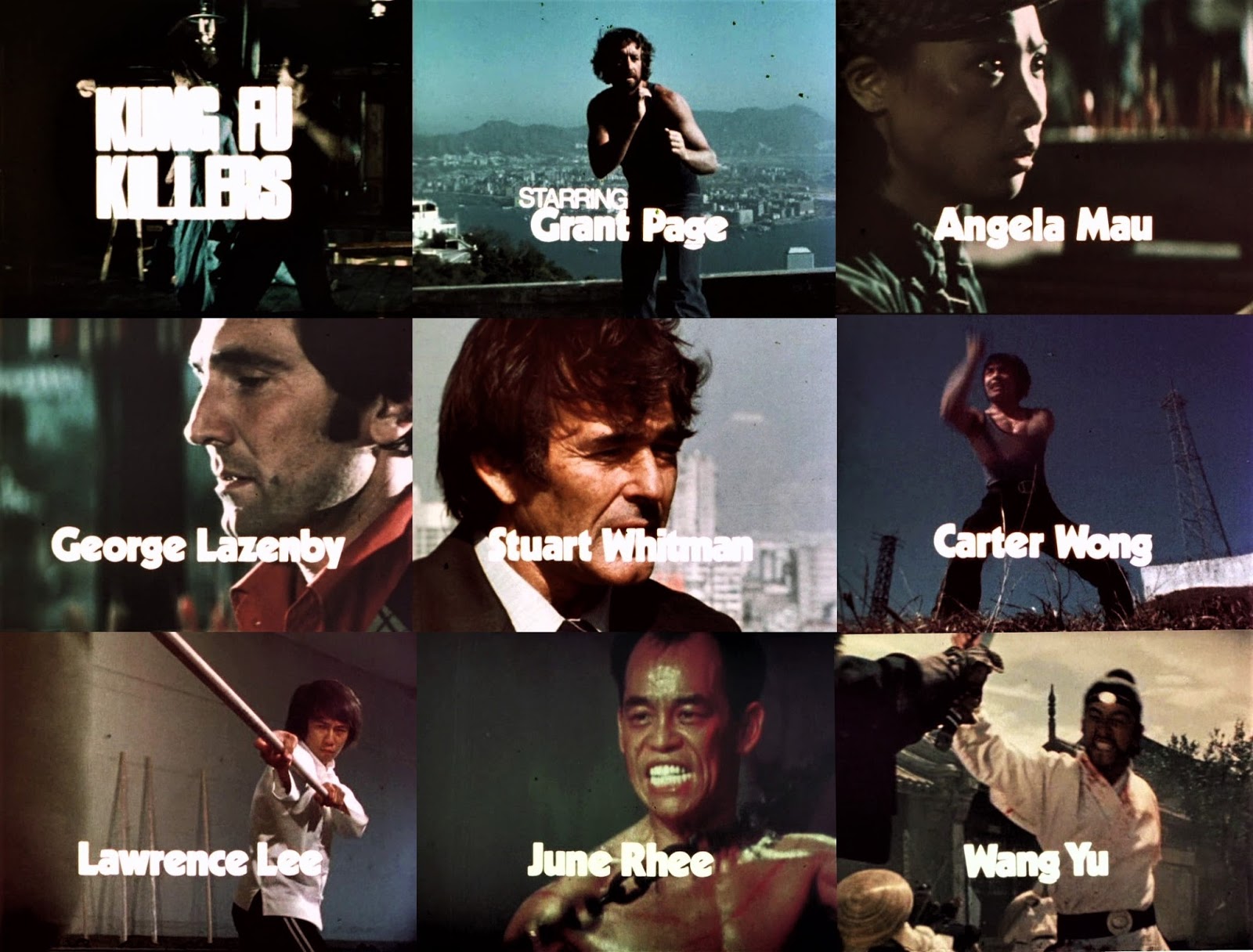
Australia, being a mere 3,500 miles from Hong Kong, was naturally very excited by the Kung Fu boom, and this documentary fronted by a hairy stuntman and climber called Grant Page profiles some of the stars of the genre, including inexplicably pleased with himself countryman George Lazenby and the indefatigable American star Stuart Whitman, already nearly 25 years into his career and looking smooth and in control, qualities he would use to sinister effect in his role as the Reverend Jim Jones in the 1979 film Guyana: Crime of the Century.   

Both men are obviously excited by the trend, not least, I suspect, because it pays them the sort of money that they can no longer command in Hollywood. When Lazenby, a self-proclaimed free soul and searcher of truth, is asked what he has learned so far he smirks and says 'beware of the Chinese'. And why not? As the arrogant occidental narrator states: 'they are not just a nation of waiters'.

Stuntman Page is not a particularly engaging or knowledgeable interviewer, but he does get into a fight – twice – with martial arts star Carter Wong, something that Michael Parkinson never did, unless you count his tussle with Emu (I don’t). Page spends some time showing off to semi-naked women in Bottoms Up, 'an upper class topless bar' if that isn't a moronic oxymoron. He also spends a lot of screen time equating martial arts to his own sport, climbing, pointing out that he uses a lot of the same muscles and has iron will power, etc. What do you expect from someone who wears a vest instead of a shirt?  

Ultimately, we don’t learn a massive amount about how to attain 'strength, peace of mind, and a love of life through the apparent study of violence' but it's an interesting period piece, full of frenetically action packed film clips of people being kicked in the face. We also see the bit from Game of Death where Bruce Lee tears out a fistful of Chuck Norris' chest hair, a spectacle I never, ever, ever tire of watching. 

Friday, 8 February 2019

STONER


d. Huang Feng (1974)
 
Originally planned as a $10m international blockbuster starring Bruce Lee, Sonny Chiba and George Lazenby, The Shrine of Ultimate Bliss was understandably compromised by Lee’s sudden death, which left a huge superstar shaped void (and no longer guaranteed box office success) and prompted the enigmatic Chiba to pack his samurai sword and go back to Japan. Rapidly regrouping, the supremely practical producer Raymond Chow slashed the budget by 9/10ths and had the ambitious script hastily rewritten to accommodate its remaining star, rangy Australian Lazenby, the man who walked out on the James Bond franchise claiming he didn’t need the degradation and could make more money elsewhere (his sole outing, 1969's On Her Majesty’s Secret Service once  underrated, is now vastly overrated. Objective reality: it’s not bad).

The end result, renamed Stoner in a number of territories to further emphasise the centrality of Lazenby’s character, is a shaggy but exhilarating mix of crime, espionage and crunching kung fu, centring around the invention, distribution and use of a new drug called Happy Pills, an opium based aphrodisiac and mind blower that has flooded the far east causing instant addiction and is now threatening places where white people live. After the drug related death of his sister, the moustachioed and slightly detestable Joshua Stoner decides to investigate, striding through the temples, night clubs and back alleys of Hong Kong in an incredibly conspicuous way, not least because he is at least a foot taller than everybody else.

Lazenby is as much tailors dummy as actor, but he does exhibit what he brought to his uneven interpretation of Bond, a sudden, brutal physicality that manifests itself in a number of fast, bruising and very convincing fight scenes. He’s no Bruce Lee, of course, but he hands out (and takes) a number of comprehensive beatings, and looks committed and convincing as he does so, aided and abetted by crunching and slapping noises dubbed loudly over the action.

He later teams up with a Taiwanese undercover cop played by the rather marvellous Angela Mao, part mouse, part lion, and the last half of the film plays out like a Bond film: they infiltrate the billionaire villain’s underground lair (he doesn’t have a white cat, instead, rather curiously, he has a spinning desk), then kill him in an interesting and grisly way and blow everything up. The End.

Additional highlights include the discordant electronics that play when anyone mentions drugs, Stoner’s taupe and caramel wardrobe and cloak clad Rupert, a deep voiced, statuesque black love guru who leads a flaky hippy sex cult made up of really scrawny white blokes and a number of dirty faced women who greedily and obscenely suck ice lollies when the Happy Pills start to kick in.