Showing posts with label Australia. Show all posts

Friday, 8 May 2020

STONE


d. Sandy Harbutt (1974)

The wide, wild and slightly lawless open country of Australia would appear to be the perfect environment for outlaw biker gangs and, indeed, some preliminary research on an obscure new thing called ‘Wikipedia’ would indicate that there are currently around a dozen such groups operating down under at the moment, the largest comprising around 2,000 members. Mainly concerned with drugs, guns and beating each other to death with clubs, I’ll bet that every single one of them has seen Stone, the first Aussie biker film, a labour of low budget love that combines a loose documentary feel with a somewhat undeveloped crime story to create a fascinating document of a previously hidden lifestyle.

When The Gravediggers, a Sydney based biker gang, witness the bloody assassination of an environmental campaigner, they find themselves under attack from an unknown assailant. Members of the gang are killed by explosion, by being forced off the road into the sea and by being decapitated by a taut wire strung across the highway. Stone, a long haired undercover cop, is assigned to the gang, initially receiving a rough welcome. As he learns more about the group he begins to understand that their lifestyle, for all its violence and anarchy, is a family that provides a home for misfits, rejects and outsiders, and that their motivations and ambitions mirror Stone’s own hitherto unexplored non-conformism (what other Aussie cop owns leather trousers?).

The film jumps from one vignette to the next, only picking up the plot with twenty minutes to go. It doesn’t matter, as what we see is engaging and thought provoking and the protagonists, although not likeable in any conventional sense, have character and realism. My main concern was the inequality between the members of the gang and their molls, a band of attractive young women who, inexplicably, are entirely besotted by the grizzly, greasy, toothless and generally quite elderly bikers. Cliché would have it that good girls love a bad boy, but these antiquated hobos haven’t been boys for quite some time. Also, they’re not particularly good girls.

There’s a great scene where Stone gets to know the gang, learning a little more about who they are, where they came from, how they ended up together. Everybody is smoking a joint, and the camera goes in and out of focus with each inhalation, a queasy but effective way of involving the audience in an intimate, intoxicated moment of relative peace before the bloody climax. Actually, there are two bloody climaxes, the second of which ends the film in a surprising but entirely satisfactory way. The final message is quite clear: you don’t ‘sort of’ belong to a biker gang, mate: you’re either in or you’re out.

Friday, 5 April 2019

THIRST


d. Rod Hardy (1979)

The 1970s was an interesting time for Australian cinema, producing perhaps half a dozen indelibly brilliant and original films. Thirst isn’t one of them, but it is rather good, and provides an interesting and cliché avoiding half turn on the standard horror mythos, depicting vampires as a powerful, hidden class of people who have money, resources, influence and their own way of doing things, a sort of undead Illuminati. 

These vampires are bound together by blood in every way, not just through their appetites but through their family connections and hundreds of years of heritage / inbreeding (so often the same thing). The most nagging detail is that the vampires have created an industrial process to ensure they have all the blood that they need, running large dairies where listless but good looking young people have their blood drained from them on a  daily basis until they are desiccated husks. The blood is then bottled or put into cartons for consumption at breakfast. I don’t suppose it’s too much different to the Gold Top I used to drink in the 1970s, which, delicious or not, most closely resembled mucous in a glass. 

My only real concern was a technical query: if vampires are born into vampirism, and are immortal, when do they stop ageing? I mean, If David Hemmings (featured here as one of the few sympathetic characters) is going to live forever, why doesn’t he do so in his young and pretty 1960s form from, say, Eye of the Devil, rather than as he appears here: grey, a bit baggy, slightly tipsy and tired, tired, tired? 

Quiet, forceful, strange, compelling, Thirst is intriguing and interesting for most of its running time, only letting itself down with some poorly fitting fang dentures and a rather silly red eye optical effect that kicks in just before the bloodsuckers bite.

Friday, 29 March 2019

PURE SHIT


d. Bert Deling (1975)

The darkly playful title refers to Heroin, a drug that continues to polarise public and private opinion but is universally agreed to be extremely more-ish. This very Australian fly on the wall documentary style film, compiled from real life junkie war stories, attracted major controversy in its time, with the censor forcing a name change to Pure S and the Vice Squad raiding the premiere. Watching it now, it’s easy to see what shook up the powers that were: the star of the film is Heroin, the pursuit of it, the taking of it, the dirty pleasure of it; when it's not onscreen the characters talk about it and crave its presence more than food, money, sex and love. 'H' is the sort of role the brilliant but ruthless egomaniac Kirk Douglas would have enjoyed playing: the undisputed centre of attention. 

The users live entirely outside of 'normal' society, only engaging with non-junkies and non-dealers when they are robbing pharmacies or prostituting themselves for cash. They are unwashed, extremely foul mouthed, obsessed with double denim and so trapped on the hamster wheel of addiction that they have no time for anything else, least of all dreams of a better future. There are no poetic and wistful monologues here: these junkies like being junkies and, of the alternatives, even a sudden puke covered death seems preferable to the hell of rehab and Methadone treatment.

It gets shrill and repetitive and muddled quite quickly, especially when the early narrative about the protagonists seeking heroin and never quite getting it goes off track. Within twenty minutes they all start clumsily and repeatedly jabbing needles into their scabby arms (I assumed that junkies would be better at injecting, or perhaps I’ve just seen too many glossy drugs films) and vomiting into buckets, revealing the full  scuzz of their grim drug addled life for all to see. These scenes are given added impact by apparently being real or, at least, seeming real, which is, after all, what cinema is about. I suppose the Aussie authorities were worried that Pure Shit might glamourise drug addiction or even provide step by step instructions on how to score and shoot up but, seriously, if you watch this film and think ‘cor, I don’t half fancy some Heroin’ you pretty much deserve what comes next.

Friday, 15 February 2019

KUNG FU KILLERS


d. Brian Trenchard-Smith (1974)


It’s difficult for today people to comprehend just how big Kung Fu was back in the 1970s. Previously seen as an ancient, esoteric, slightly shifty thing that foreigners did, the phenomenal success of Enter the Dragon turned the rabid consumers and novelty seekers of the West onto all arts martial, including karate style pyjamas which my brother and I plagued our parents for and then wore to chop and high kick the shit out of each other. 

I can remember being ill in 1974 with whooping cough, sat out on a blanket in the back garden (it was the Summer, not some extreme form of quarantine) and reading a big pile of Marvel comics, every single one of which featured either a black or Asian protagonist absolutely expert in martial arts. Later on, my Mum called me in to watch Hong Kong Phooey. Man, those were literally the days, being approximately twenty four hour periods of solar rotation that have now passed.

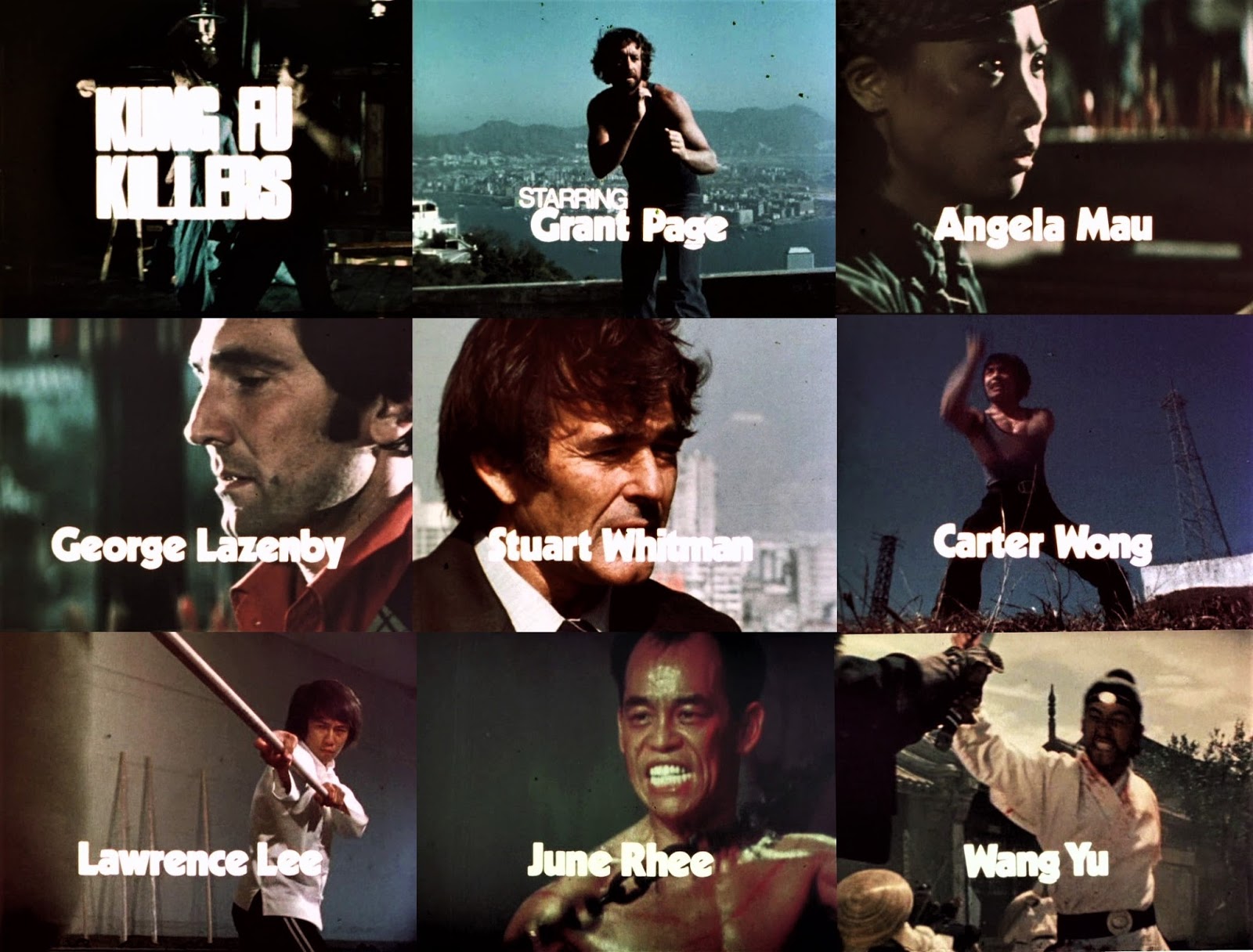
Australia, being a mere 3,500 miles from Hong Kong, was naturally very excited by the Kung Fu boom, and this documentary fronted by a hairy stuntman and climber called Grant Page profiles some of the stars of the genre, including inexplicably pleased with himself countryman George Lazenby and the indefatigable American star Stuart Whitman, already nearly 25 years into his career and looking smooth and in control, qualities he would use to sinister effect in his role as the Reverend Jim Jones in the 1979 film Guyana: Crime of the Century.   

Both men are obviously excited by the trend, not least, I suspect, because it pays them the sort of money that they can no longer command in Hollywood. When Lazenby, a self-proclaimed free soul and searcher of truth, is asked what he has learned so far he smirks and says 'beware of the Chinese'. And why not? As the arrogant occidental narrator states: 'they are not just a nation of waiters'.

Stuntman Page is not a particularly engaging or knowledgeable interviewer, but he does get into a fight – twice – with martial arts star Carter Wong, something that Michael Parkinson never did, unless you count his tussle with Emu (I don’t). Page spends some time showing off to semi-naked women in Bottoms Up, 'an upper class topless bar' if that isn't a moronic oxymoron. He also spends a lot of screen time equating martial arts to his own sport, climbing, pointing out that he uses a lot of the same muscles and has iron will power, etc. What do you expect from someone who wears a vest instead of a shirt?  

Ultimately, we don’t learn a massive amount about how to attain 'strength, peace of mind, and a love of life through the apparent study of violence' but it's an interesting period piece, full of frenetically action packed film clips of people being kicked in the face. We also see the bit from Game of Death where Bruce Lee tears out a fistful of Chuck Norris' chest hair, a spectacle I never, ever, ever tire of watching.