Friday, 11 December 2020

MAN BEAST


d. Jerry Warren (1956)

My expectations were low for this film, so I was pleasantly surprised to find myself watching lots of (generally well filmed) footage of a small group of people traipsing through snow and climbing mountains hunting for the Abominable Snowman, especially as, every now and again, a scruffy looking Yeti would appear from behind a rock or from a hole in the ice to watch their progress and shake his manky head at the folly of it all. Then, towards the end of the film, when a sinister mountain guide ripped open his silk chemise to reveal a coarsely matted white hairy chest, declaiming that he was part Yeti himself, I choked on my can of Lilt and ascended into psychotronic heaven powered by the sheer silly brilliance of it all.  

It seems that the Yeti are simultaneously at several stages of evolution. Some look like albino gorillas with skulls for faces (they mainly do the heavy work); some are more man than beast, facilitated by a breeding programme with kidnapped local women. The sinister mountain guide is particularly excited about getting his hands on the sole female in the expedition, an American woman, as he believes that their offspring would perhaps skip two generations of development, maybe putting a Yeti in the White House by the year 2,000.

Triple threat film maker Jerry Warren is often criticised for the sheer shoddiness of much of his output, but, on this evidence, he could also put something half way decent together when he wanted to. Man Beast is cheap, yes, but it is also fun, engaging, surprising and the mountain footage is nicely done. Sure, it's no La Regle du jeu, but then I've always thought the highly rated French classic conspicuously lacking in Yeti action.       

BEYOND THE TIME BARRIER


d. Edgar G. Ulmer (1960)

A super cheap sci fi b-movie made on an abandoned air base in just ten days, Beyond The Time Barrier isn't exactly 'the most terrifying film ever made'*, but it is a tiny triumph over adversity, a testament to the ingenuity, imagination and determination of its director, Edgar G. Ulmer - and his family, who worked on the production in various roles.

When a USAF test pilot breaks the sound barrier and the time barrier in a new plane, he finds himself projected forward to the year 2024. Things are fairly grim in the future as a space plague has split mankind into two groups: murderous bald mutants, and deaf mute 'survivors' who have become sterile. The only fertile woman on the planet is wheeled out to mate with the test pilot and, as she's rather attractive, he's not too put out, although another time traveller, a bloody Russian, is about to put a mighty spoke in the works...

Ulmer started his film career as a set designer and, no matter how cheap his films are, they always have a very definite look. Here, the survivors live underground in a sort of geodesic pyramid. From the outside it's clearly a drawing but, inside, it is nicely realised, halfway between a bomb shelter and a holiday camp, made up of dozens of interlocking triangular panels. In a nice touch, Ulmer doesn't just fade the scenes in the pyramid out, but uses triangular ellipses to move from place to place. It's  a small but important point: Ulmer isn't just here to make pointless trash: he has a vision, and he manages to bring it to screen on a shoestring. Regardless of the results, I think that's quite an achievement.   

* The trailer makes quite a lot of unsubstantiated claims. 

Friday, 4 December 2020

NIGHT OF THE LEPUS


d. William F. Claxton (1972)

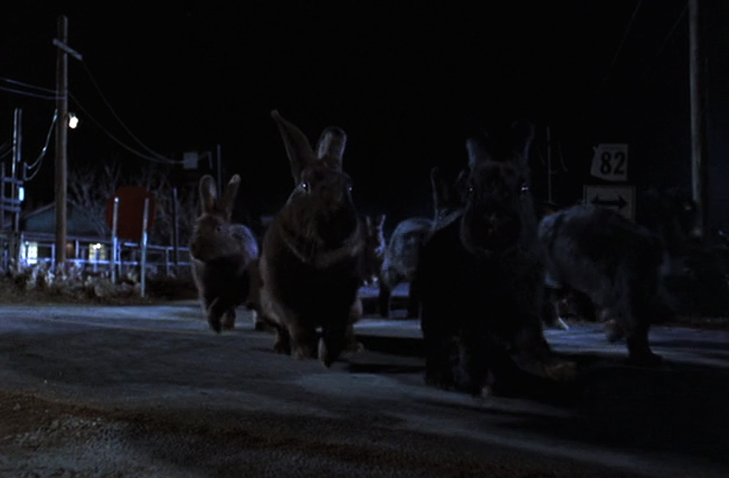
Everybody knows that rabbits aren't scary or threatening, no matter how massive they are or how much ketchup you smear around their mouths and adorable twitching noses.This simple fact, seemingly ignored by all involved in this farcical production, completely destroys any scintilla of authenticity from the opening shot onwards. After 90 minutes, as we watch hundreds upon hundreds of giant rabbits shot to bits and electrocuted, we don't feel any relief that a scruffy piece of American desert and a few hillbillies have been saved, we just feel desperately sad for the slaughter and a little bit dirty, like Sir Stanley Baker at the end of Zulu.

The overgrown 'lepus' haven't been created by 'bad' science in this instance - their rapid growth, rampant aggression and unexpected liking for human meat is actually the result of humane, experimental work to inhibit their breeding and save them from a total cull. Put that in your irony pipe and puff it, PETA. The test tube work is done by an idealistic 'young couple' Stuart Whitman and Janet Leigh (both in their mid forties but looking much older) but is inadvertently compromised by their young daughter, who can't resist playing with the fluffy specimens and accidentally mixes up the test subjects - with preposterous results.  

This small but pivotal role was originally earmarked for the teenage Jamie Lee Curtis, until Mum Janet vetoed it: she didn't want her little girl anywhere near a horror film.

Anyway, if you do have a rabbit, go and stroke it. Other pets / euphemisms may very well apply.  

Friday, 27 November 2020

INVASION OF THE BEE GIRLS


d. Denis Sanders (1973) 

For a long while, Invasion Of The Bee Girls requires some perseverance. A patchy story about a series of unexplained deaths in a small town with a large biological research centre, the key point of interest is that the victims are exclusively men, specifically middle aged scientists, most of whom have some form of ingenious and elaborate comb across. Their sudden demise is attributed to being (using the 70s vernacular) 'balled' to death. Are their murders linked to the top secret work they are doing? And isn't the town (brilliantly, called Peckham) notorious for being a swinger's paradise? And why do all the women in town wear such big sunglasses?* 

After an hour, however, there is an extraordinary sequence in which a group of very short white coated women perform a strange procedure on a naked, half conscious lady stood in front of a Buckminster Fuller-style geodesic dome made of electrical cable. They bombard her with radiation, smear her in latex, then lock her away in a compartment filled with bees, which cover her entirely. After this, they peel off the plastic and flash her with a heat ray. The soft light and warmth of the light unlocks something sensual within her - and does the same for the other women in the lab - and there is much wistful self-fondling. One lesbian kiss later and the subject's eyes turn completely black. She is now a bee girl. Her mission: to copulate an ugly old scientist to death. The reason: less clear cut, but it has to do with chauvinistic and irresponsible experiments causing female sterility or something. 

When the film was released on video in the UK it was re-titled 'Graveyard Tramps', which only makes me think of cider and public urination. I'm not quite sure why, but I seem to watch this film three or four times a year. It's become some sort of 'go to' film for a recurring mood: slightly pissed off, at a loose end, nowhere near ready for bed, in need of something slightly incomprehensible and full of weird. It's never let me down yet.   

I'd like to write a book about it one day. But just a short one. Send money and crayons.

* The credits read 'Bee Come Beautiful Sunglasses by Foster Grant'.

Friday, 20 November 2020

THE BEES

d. Alfredo Zacarias (1978)

'You have to listen to what the bees have to say!'

Mankind has a contradictory attitude towards bees, being both completely dependent on them for the continuation of human life on this planet, and simultaneously determined on eradicating them completely in pursuit of short term profit. As a child, I was once chased by a swarm of bees and stung dozens of times, but I don't hold a grudge: they were just doing their job and, after some brief discomfort, I was perfectly fine, although somewhat reluctant to cross them again.

The Bees is a brilliant, chaotic film. Totally cobbled together, it's difficult to know what is more awkward, the mismatched stock footage of plane and helicopter crashes and social panic (at one point, despite the film being set in the modern day and in Mexico and USA, we see obviously British people from the 1960s running past the Ilford Curzon) or  the dodgy optical effects, including what looks like green soot smeared on the negative to represent huge clouds of deadly bees. Every scene is scored with unsuitable music: people die in agony accompanied by ragtime piano, or atonal jazz. There's an appearance from ex-president Gerald Ford (in news footage) and then president Jimmy Carter (played by an impersonator). The elderly John Carradine does a silly German accent, and is taken out by hitmen. 

The Bees in question are imbued with an almost mystical quality, directed from a glowing, throbbing mega-hive in a cave. The upshot is that the bees aren't just killing people because they can, but because they are the vanguard of the defence of mother nature. Sick of having her natural resources used and abused by man, she has sent '20 trillion' bees to teach them a lesson, culminating in a swarm of bees holding the United Nations to ransom. 

Stars John Saxon and Angel Tompkins do the only thing they can and enjoy themselves, providing the film with a basic core of grace, good nature and fun. It's a film that is hilariously funny, not in a sneering way, but just because it is silly and ridiculous and doesn't take itself at all seriously. The funniest thing of all is that Paramount paid the producers a million dollars not to release the film before their own big budget take on the theme, The Swarm. They needn't have bothered, The Swarm was a massive flop, notable only for Michael Caine's immortal words (read aloud, using 'the voice'): 'I never dreamed it would turn out to be the bees. They've always been our friends'. 

Friday, 13 November 2020

DEMENTIA 13


d. Francis Ford Coppola (1963)

A rather murky tale of intrigue and murder set in Ireland, the plot revolves around that most baleful of storylines, the death of a child and the terrible, dysfunctional, psychotic effect it has on an already eccentric (and not Irish in the slightest) family.

The young Francis Coppola wrote and directed the film, the culmination of a short apprenticeship with producer and director Roger Corman that had seen him doing anything and everything from editing, dubbing and script writing to the washing up and driving. Corman worked his interns pretty hard, but he was also remarkably astute about talent and very generous with opportunities. When 'The Young Racers' concluded under budget and ahead of schedule, Corman decided to maximise the saving by giving Coppola forty grand, nine days and Samuel Beckett's favourite actor* to make his very own film - as long as it was a bit like Psycho**.

The script (written more or less overnight) is, perhaps not unexpectedly, a little uneven, and the direction is occasionally self-conscious but, overall, it's an impressive achievement, not least because of the atmosphere of sustained dread it creates and some nicely realised underwater shots. There's also a short monologue about a recurring nightmare and incipient madness that makes you stop everything that you're doing to listen to it, including breathing.

* I am referring, of course, to the amazing Patrick Magee, an actor with a sinister voice somewhere between a purr and a croak and an extraordinary intensity. I was going to describe him as immortal, but he died in 1982, and I thought somebody might write in.

** The opportunity turned out to be a parting gift: Corman hated the film, and Coppola went his own way after the test screening.

Friday, 6 November 2020

THE MAN FROM PLANET X


d. Edgar G. Ulmer (1951) 

An interesting attempt at making a film about an alien invasion on a tiny budget and with only a few painted sets and some scale models to help set the scene, The Man From Planet X is notable for two things: it's supposed location, and the X Man himself, who is an amazing and surprising creation.

The film is supposedly set on the 'Scotch' island of Bury, a place of fog and moors and fishermen with stick on sideburns and a variety of accents. Bury will be the closest point on Earth when the newly discovered Planet X's orbit brings it close to our world for the first time. As such, some scientists and a journalist have gathered there to more closely observe the arrival of X, little realising that the mysterious sphere is populated, and that the inhabitants are mainly interested in decamping from their place to ours.

Which brings us to the X Man, the 'fantastic gnome': a small, rather feeble humanoid in a cumbersome space suit that is reminiscent of a deep sea diving outfit. The alien's face resembles crude, ancient figurative art, with stretched and elongated features, something like Humpty Dumpty's face etched onto sandstone. It's both creepy and rather sad, especially as the X Man seems permanently terrified. It takes a little spark of genius to imagine a life form that is recognisably a 'person' but also completely alien: the really clever part is that the X man appears to be made out of geological rather than biological material.       

We learn that Planet X is icing over, and will soon be unable to support life. The funny faced envoy is not unreasonable in the first instance but, once he's been beaten up and the military have been called in he gets a lot more aggressive, using a mind control ray to get the help he needs from the locals to trigger a full scale invasion.

Mankind triumphs in the end, of course. The army blow the X Man and his rocket to bits and so Planet X swings out of orbit without making contact, disappearing out into the farthest reaches of space on a trajectory of frozen doom. Hurrah, we should all be very proud of ourselves.