Showing posts with label USA. Show all posts

Friday, 2 April 2021

FREUD: THE SECRET PASSION

d. John Huston (1962)

Freud: The Secret Passion is an important entry in the psychoanalysis sub-genre, not least because it is effectively a biopic of psychiatric practice. Directed by genius journeyman John Huston and starring poor old Montgomery Clift as an obsessive and controversial Sigmund Freud, the narrative alternates between intense hypnotic therapy sessions and gauzy interludes from Freud's own personal history which serve to help him iron out the wrinkles in his own crumpled psyche. Although the depiction of treatment is greatly simplified and the outcomes far more emphatic than in reality, the film does a good job in joining the dots, ably assisted by excellent performances, moody music and a feeling of eerie, scalp prickling mystery. In many ways, Freud is a horror film or, at least, a film about ghosts, where the haunted house is the human mind.


Clift burns at the centre of the film, his damaged face conveying the agony of the seeker as he obsessively pursues his goal, alienating his family and scandalising his peers as he relentlessly moves towards understanding. It's an outstanding performance, but Clift was apparently difficult on set, and this caused the film to go over budget, effectively ending his career.


Clift had always been demanding and, after his near fatal car crash in 1956 became increasingly erratic - but he still made money. In Hollywood, then as now, you can self-medicate and misbehave all you like, but as soon as you start cutting into the profits, you're finished.

Friday, 22 January 2021

DEATH PROMISE


d. Robert Warmflash (1977) 

When I was at junior school, about a thousand years ago, once a week our teacher Mr. Crockett would let us perform a play of our own devising on a rotational basis. In my group - boys only, of course, because girls were horrible  - we never really put much effort in, either blatantly ripping off something we’d seen on telly or coming up with some nonsense about robot teachers or someone setting fire to the school. When inspiration ran completely dry, we often just improvised, returning again and again to the twin preoccupations of pre-pubescent boys: fighting and friendship. These 'plays' involved kung fu, sword fights, stabbings, stranglings, shootings, wrestling, boxing and a huge amount of male bonding: hand shaking, back patting, affectionate arm punching. The high five hadn't caught on in the UK at the time, and the fist bump was still under development. It was an amateurish, childish vision of what it meant to be a grown up man: violence, camaraderie, heroism, cuddling, no women. And that, dear reader, is what Death Promise reminded me of.  

Two tough New York guys, one white, one black, one short, one tall, neither in any kind of employment, spend their days jogging in matching track suits and training – hard – at the martial arts club. To show that they are friends, they touch each other constantly. When ruthless developers try to evict them from their apartment building, using a variety of nefarious means (turning off the utilities, starting a fire, infesting the building with rats) the guys find any number of arses to kick, somewhatr exacerbating the problem and culminating in the murder of the short white guy’s father. Eaten up by grief, hungry for revenge, he flies off to an exotic dojo where he becomes so disciplined that he can catch a fly with a pair of chopsticks. Shit hot and invincible, he returns to the Big Apple to kill those dirty scumbag landlords one by one: by bow and arrow, by poison, by putting a bag of angry, hungry rats on someone’s head.

Each time he crosses a name off the list he and his tall, black friend nod sagely, clasp hands and look into each other’s eyes for just a beat too long. It's very funny, not because it’s homoerotic but because it absolutely isn't.   

Somewhat stilted in terms of drama, the film only really comes to life during the fight sequences,  although luckily these take up about 75% of the films running time. The last half hour is literally just one big battle, eventually descending into hysterical madness as angry men scream wildly and uncontrollably at each other, tearing off their tight shirts to kick and punch the shit out of each other really slowly. It ends with a dummy representing the main villain being thrown off a roof, and it’s not a good dummy either - which is great. Highly recommended!  

Friday, 15 January 2021

DEATH BY INVITATION


d. Ken Friedman (1971)

If you’re looking for pace and excitement, then this film is not for you. Languid to the point of being in a stupor, the story concerns a reincarnated witch, Lise (Shelby Levington, excellent), who, three hundred years after her execution in Salem, is able to wreak her revenge on the descendants of her chief persecutor in modern day Staten Island.

Lise is attractive, intelligent, nonchalant, cool and sexy as hell. She starts by insinuating herself into the family as a trusted friend, before callously killing the family’s teenage son, and suspending his dismembered corpse in a plastic bag in a cupboard. She then decapitates their teenage daughter and ‘helps’ their six year old girl fall down the stairs to her death. All the while she wears black and pulls sympathetic faces, supporting the family through their grief as she plans her next diabolical move, building up to taking out the patriarch, a bumptious, arrogant drunk who just happens to look exactly like the man who killed her all those centuries ago.

Lise is not really a witch by deed: she doesn’t cast any spells or hop about in the nude invoking the goat of Mendes or Gaia or whoever or whatever witches invoke. In fact, there is no evidence that she ever sticks a pin in anything. Lise is a witch by character, full of strength, resolve, defiance. Her mission is about revenge, pure and simple, executed with strength and cold, relentless intent.

Right at the beginning of the film, Lise tells the nerdy, doomed teenage son a long story about a primitive tribe where women were the leaders and the hunters and the men merely acolytes and hand servants. When the women were challenged by an alpha male, they pursued him through the woods and, when they caught up with the upstart, tore him apart with their hands and teeth for his impudence. It’s a mesmerising monologue, performed well, and lets us know that she can’t stop, won’t stop in her mission, despite the fact that, with the exception of the father, who is a real piece of work, the rest of her victims seem ordinary, totally harmless, certainly undeserving of death and misery and loss on the scale inflicted upon them. Their niceness is irrelevant, however, Lise wants her pound of flesh, and isn’t bothered about how she balances the scales.

A slow but quietly immersive film, reeking of comedown and 1971, that only loses points towards the end by having Lise fall for a guy who bullies her into loving him and thus diminishes her powers and her will to kill. As if.

Friday, 4 December 2020

NIGHT OF THE LEPUS


d. William F. Claxton (1972)

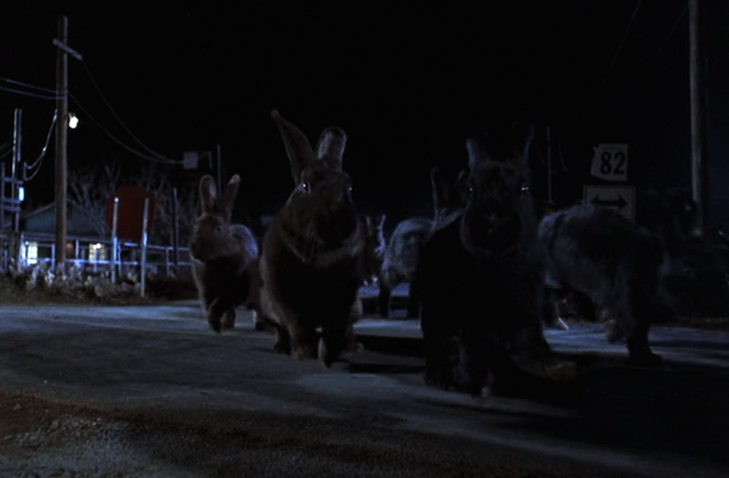
Everybody knows that rabbits aren't scary or threatening, no matter how massive they are or how much ketchup you smear around their mouths and adorable twitching noses.This simple fact, seemingly ignored by all involved in this farcical production, completely destroys any scintilla of authenticity from the opening shot onwards. After 90 minutes, as we watch hundreds upon hundreds of giant rabbits shot to bits and electrocuted, we don't feel any relief that a scruffy piece of American desert and a few hillbillies have been saved, we just feel desperately sad for the slaughter and a little bit dirty, like Sir Stanley Baker at the end of Zulu.

The overgrown 'lepus' haven't been created by 'bad' science in this instance - their rapid growth, rampant aggression and unexpected liking for human meat is actually the result of humane, experimental work to inhibit their breeding and save them from a total cull. Put that in your irony pipe and puff it, PETA. The test tube work is done by an idealistic 'young couple' Stuart Whitman and Janet Leigh (both in their mid forties but looking much older) but is inadvertently compromised by their young daughter, who can't resist playing with the fluffy specimens and accidentally mixes up the test subjects - with preposterous results.  

This small but pivotal role was originally earmarked for the teenage Jamie Lee Curtis, until Mum Janet vetoed it: she didn't want her little girl anywhere near a horror film.

Anyway, if you do have a rabbit, go and stroke it. Other pets / euphemisms may very well apply.  

Friday, 16 October 2020

SATAN'S CHILDREN


d. Joe Wiezycki (1975)

Rape revenge films are always mean and tawdry: no matter how satisfying the revenge element is, there always has to be a disturbing attack to set up the story. Here, there's a slight twist on standard exploitation mores: the victim is a teenage boy, a runaway from an intolerable home life who meets an older guy who he hopes will be a friend and mentor but instead turns out to be  the scumbag leader of a gang of scumbag abusers. The scumbags all take a turn with the unfortunate youngster then dump his ripped and torn body in the middle of nowhere, where he is discovered, semi-conscious, by a group of satanists. How lucky can one boy be?

The satanists are all young, hippy-ish and in the thrall of a super louche smoothie called Simon, who gives orders in a slow, quiet voice whilst fiddling with his Zapata moustache. He talks of The Master as if he were the area manager. It's a ridiculously tough group – disciplinary infractions are punished by execution by hanging or, if they're being generous, by burying you up to your neck in sand and covering your hair in syrup to attract the ants.

Strangely for an unconventional cult of sexual freedom and social anarchy they are dead set against homosexuality to the extent that poor Bobby, even as a rape victim, is treated with suspicion and labelled a 'loser' who was 'weak' enough to 'let' himself be abused.

The only way Bobby can prove himself is in the bloodiest terms possible. He escapes, pushes two of the pursuing Satanists into quicksand (actually a hole filled with plaster of paris and washing up liquid), goes home, hits his mean Dad over the head with a bottle and bundles his wicked stepsister into the boot of his car before finding and shooting his attackers and cutting off their heads and putting them in a bag which he presents to Simon as proof of his sincerity, proving himself as a ‘winner’: a bright eyed boy with a bright arsed future. His stepsister (who is more unpleasant than plain evil) is handed over to the group as a kind of cult-warming present, to be tortured and, eventually, crucified.

It’s a remarkable film, really, despite clear technical limitations: the sound often overlaps or gets suddenly cut off; special effects and pyrotechnics are on show; several key scenes lose dramatic intensity by simply being too dark. The cast is made up entirely of students, which occasionally shows, but actually helps create a terrifying vision of a post-Manson USA where disaffected youths are being corrupted, abused, degraded and turned to the dark side all across the country without anyone knowing about it.

Friday, 11 September 2020

BLOOD FREAK


d. Brad F. Grinter (1972)

We've all seen cautionary tales about the dangers of drug consumption, and those of us who like our films psychotronic will have seen our fair share of movies about the transformative powers of mad and unsanctioned science. Blood Freak manages to combine these two hot topics to present us with the far out story of a narcotics fiend who turns into a turkey.

Hunky Herschell is just back from Vietnam, with only a badly burned arm and a dope habit to show for his tour of duty. While riding from town to town on his chopper, he meets up with Angel, a Bible spouting dolly bird who, despite her obvious moral rectitude, takes him to a hippy drug party and introduces him to her wilder and more switched on sister, Ann. Sultry Ann sets her cap at the upright, uptight Herschell, and conspires with her sleazy drug dealer to get her target to smoke an instantly addictive joint, after which he falls into bed with her.

Herschell gets a job at the local poultry farm where, for extra cash, he chows down on turkey that has been illegally experimented upon. Soon afterwards he has a seizure and, when he wakes up, he is surprised to find (as are we) that he has the big, gnarled head of a turkey cock and major collywobbles from drug comedown. Actual turkey, cold turkey: it’s a very clever metaphor. Doubly damned, he now creeps about grabbing addicts and slitting their throats, drinking their dope rich blood like coca cola while his supposedly dead victims cough and splutter as the strawberry syrup goes into their eyes and up their noses. 

This madness is interspersed with sardonic commentary from director, Brad F. Grinter, a permanently smoking grizzled guy who has clearly lived hard and well and reads his erudite words from an offscreen piece of paper, perhaps due to short term memory loss. Grinter concludes this outrageous story by saying that it is 'partly based on fact, partly based on probability', clearly bullshit. In the end analysis, though, this is a film about a vampire turkey that manages to entertain without a knowing nod, a wink or an arched eyebrow, so it's pretty much beyond normal criticism as far as I'm concerned. 

Friday, 4 September 2020

OCTAMAN


d. Harry Essex (1971)

Octaman isn't a very good film in any respect, but it has a massive amount of chutzpah, not least in its ambition to make a feature length movie with virtually no budget and hardly any script. Half of what money there was must have gone on two past their best name actors: former Gulliver, Sinbad and Jack the Giant Killer, Kerwin Matthews, and Italian erstwhile ingenue Pier Angeli, who would accidentally overdose on barbiturates shortly after the production wrapped (I say ‘accidentally’, but perhaps she was trying to avoid attending the premiere).

The rest of the cash was obviously spent on the Octaman rubber suit, because we see it from every angle - and it looks pretty good: two legs, six tentacles and a dome shaped head, fiery red eyes and a hideous toothy hole for a mouth, a perennially open 'o' that looks a bit like Paul McCartney's mouth, or a cats arse.  We don’t see any obvious zips or a visible pant line (common monster costume mistakes) but we can see that the suit is in two parts, the bottom half of which is the world’s craziest and leggiest pair of green slacks.

As in most monster films, the Octaman wants revenge on the humans who have encroached on his land and ruined it (as you might surmise from the existence of a massive, land walking octopus, Octaman has been mutated by industrial pollution) but here they have also stolen two of his kids, one of which died in a bucket en route to the lab, with the other dissected alive by a local 'scientist' (he doesn't even wash his hands). What follows is a cat and mouse chase, assuming the cat is a bloke in a rubber suit who moves very, very slowly and the mice are idiots who do everything they can to continually blunder into the cat's flailing tentacles. 


Lives are lost, lives are saved, guns are cocked, shots are fired. There's a subplot about a failing circus and the two main characters are a sweet couple, middle aged people engaged to each other. After what seems like a long time, Octaman is finally shot enough to disappear back into the toxic water with an ignominious plop. Often, films like these try to finish on an ambiguous note or perhaps set the scene for a sequel, but here 'The End' appears before the ripples have even subsided, no question mark, no ellipsis, that's the end of that.

Friday, 28 August 2020

SASQUATCH: THE LEGEND OF BIGFOOT


d. Ed Ragozzino (1976)

Cryptozoology was all the rage in the mid 70s, and Big Foot was very big news in entertainment indeed, like a hairier Elton John. This curious film follows an expedition to find the legendary man of the woods, bringing together a motley group of scientists and native guides who spend months travelling into the heart of British Columbia, a densely forested wilderness covering 365,000 square miles*: the perfect place for a furry hominid who has absolutely no interest in being captured, prodded about and put into a zoo.

The film is documentary style, interspersed with recreations of famous Big Foot sightings and attacks. It's a mix of travelogue and nature film, and is really rather restful. There's some light comedy at the expense of the comical cook (who is, nevertheless, a crack shot), but mainly its just sun dappled shots of men on horses making their way carefully and slowly through a succession of beautiful, lonely settings.

There are a couple of animal attacks: a bobcat tries to eat a horse and is shot (the attack is staged, but the shooting looks authentic and leaves a bad taste) and a grizzly bear attacks an inattentive sentry (this was apparently achieved by putting Tootsie Rolls on a stuntman's shoulders, and letting the trained bear have a nibble). This latter sequence is hard to watch without smiling, probably not the intention.    

After a long while, the expedition hears a piercing and blood-chilling scream: finally, they are in Big Foot country. Big Foot clearly doesn't like visitors as he and a few friends very quickly trash the camp, throwing boulders and tree trunks with insouciant ease and breaking all the high tech equipment and a few limbs. The expeditions plan to shoot one with a tranquiliser dart comes to precisely naught, and, in the blessed relief of the morning, thoroughly defeated and lucky to be alive, they pack their smashed up shit and head for home.

We don't see much of Big Foot, just some huge, shaggy, shadowy figures in the dark, but it's enough. I don't necessarily believe in Sasquatch, but I don't necessarily disbelieve, if you know what I mean. If there is something out there, and there just might be, it will come and say 'hi' when it's ready, maybe never, which, ultimately, seems to be the moral of this tale: Big Foot likes its privacy, so don't mess with it. 

* To put this into perspective, this is the equivalent area of the entire British Isles and surrounding sea, half of Belgium, all of Luxembourg and France as far as Paris. It not only makes you realise that Big Foot could hide there indefinitely but also makes you wonder what else is in there.

Friday, 7 August 2020

I DRINK YOUR BLOOD


d. David E. Durston (1970)

From the sensational title down, this fun and fast moving film is not what you’d call family viewing,  but the violence - a severed foot, a severed hand, a severed head - a stabbing where some guts falls out of the hole - is almost quaint, relying on unconvincing paper mache body parts and chunks of raw liver. Despite this, it has a reputation as a nasty film, perhaps because its main plot point is that a child injects meat pies with the dirty blood of a rabid dog in order to get his own back on the Satan worshipping hippies who raped his sister and made his granddad take LSD. That's the most unsavoury sentence I have ever written.

The Satan worshipping hippies are a multiracial Mansonesque group of scumbags who travel around backwoods America in a smelly black van stealing, squatting and spreading STDs. They’re despicable and cruel people who, in their desire to be utterly free, oppress everybody they come across, including  rats, which they hunt down and kill with great glee and sadistic violence. Under normal circumstances, I wouldn’t condone infecting anyone with a fatal disease but, in this case, they more than deserve it. Justice is a fickle thing, however, as the rabies doesn’t kill them straight away, instead turning them into dribbling kill and sex crazy zombie death bombs, staggering about biting people and spreading the infection like wildfire. Like all hippies, rabid or otherwise, they retain a great fear of running water, and this comes in handy for the few beleaguered residents that they haven’t managed to nibble on, include the ingenious lad who put the poison in the pie in the first place. Let’s hope somebody calls the army or, at the very least, the dog pound.   

Obviously cheap but well made, with some surprisingly good performances, I Drink Your Blood is trashy, and not exactly nice, but neither is it nasty, so pantomimic and gleeful is it in its mayhem and gore. I really enjoyed it, but then there’s something wrong with me. Fact.    

A special note about the film’s earthy synthesizer score, which is smeared all over and is completely off the chain. It was written and performed by Clay Pitts, who usually worked on Christian rock records and was clearly not a man afraid to diversify. Good work, Clay. 

Friday, 3 July 2020

MANSON


d. Laurence Merrick / Robert Hendrickson (1973)

I actually first watched this a few weeks before Charles Manson died, so maybe I inadvertently dialled up the cosmos and reminded it that Manson was still around and needn’t be.  I don't feel bad, by the way, Manson was a nuisance, and never did anything good for anybody, least of all himself.

This well-made documentary, which benefits from archive footage made by The Manson Family themselves, was released two years after the longest trial in American history, a fraught, complex thing in which a man was convicted of heinous crimes which he encouraged but took no physical part in. Manson was the ultimate bad influence, a lifelong criminal and misfit who collected hippies and runaway kids and brainwashed them into becoming a nihilistic death cult using sex, drugs and endless rambling monologues / lectures about race wars, societal breakdown and how Hollywood needed to pay for ignoring his musical genius.*

If you were wondering how Manson, a short, scruffy bloke with anger issues (a bit like Hitler) managed to keep at least thirty people under his thrall, ultimately getting them to kill for him, just watch  the interview footage with some of the fringe Family members, the ones that didn’t murder anyone and drifted away from the core soon after. One of the guys tells a rambling and obviously untrue story about how he talked to squirrels and rabbits in the desert while his audience, a gang of barefoot, snaggle toothed long hairs, none older than 25, sit agape, occasionally guffawing with raucous laughter. They are either cretins who genuinely find this bullshit interesting and funny, or they’re too scared to show that they’re not hip enough to be in on the joke. Chemicals play a part, of course, but there’s also an active disavowal of intelligence, a suspension of disbelief and critical faculties in order to be part of something, to be included, to belong. For someone like Manson, 'a Venus Flytrap amongst the flower children', they were easy pickings.

We also see the girls Manson left behind, those fizzing with resentment at not being in jail but still worshipping at their guru’s feet. They pontificate and philosophise, posturing with weapons and acting tough. One of them, Squeaky Fromme, gives us a lecture about how you should know every part of your weapon intimately as she struggles to pull her knife out of its scabbard. In 1975, Fromme tried to shoot President Ford, but her gun didn’t go off.  

Cannily, the film makers withhold Manson's voice from us until the very end. When he speaks, you hear exactly where his acolytes have got their opinions, their attitudes, their words, even their intonations, cadences and pronunciations. Yes, he is charismatic, not least because he is deeply unusual and utterly self-possessed, but I don’t feel like I want to carve the word ‘pig’ on anyone’s stomach for him. Perhaps I need more drugs. Send more drugs. 

* There is a persistent rumour that Manson auditioned for The Monkees. He was actually in prison at the time. I don’t think he’d have got the job, anyway, they already had Davy Jones.

Friday, 29 May 2020

THE DARK


d. John Cardos (1979)

The original storyline for The Dark was fairly straightforward: an abused child is held prisoner in an attic until he reaches adulthood. When a house fire kills his abusers and sets him free he heads to the city and, completely unhinged, begins a brutal killing spree, averaging a murder a night and earning the nickname ‘The Mangler’. With the death count rising, it’s up to the Police, an investigative journalist, the father of a murdered girl and an eccentric psychic to find The Mangler and stop him in his tracks. It’s not exactly Shakespeare, but it works. Halfway through filming, having already fired director Tobe Hooper, the producers decided that aliens were the big thing, so The Mangler should be an alien, effectively throwing the film against the wall and letting it slide ignobly to the ground, bloodied and bent out of shape.

The alien looks like a werewolf or a make-up free Gene Simmons in a lumberjack outfit, a huge shambling thing with grey, putrid flesh. It possesses enormous strength, is impervious to bullets* and can fire lasers from its eyes, and, believe me, it fires lasers from its eyes a lot. It doesn’t like being set fire to but then, to be honest, who does?  In the end analysis, it’s an extremely crappy thing to ruin a film for, and what remains is a mass of non-sequiturs and undeveloped detail, with promising characters and situations cut off and cauterised in favour of expedient gimmickry that doesn’t make any kind of dramatic or cinematic sense.

As a final insult, the producers bookend the ruin with bullshit, firstly with a caption which pontificates about the certainty of life on other planets and that, like some nasty earth creatures, aliens might prove to be aggressive and deadly to man and, finally, with a concluding narration in a gravelly voice which states 'it was an encounter that has no explanation or understanding', i.e. 'Fuck knows what happened there. Right, see you later’. It’s extremely unsatisfactory, especially as it wastes a decent cast, a good cinematographer, Panavision, a $2m dollar budget and an unusual and interesting score** – this isn’t shoestring or amateur film-making, it’s just what happens when artless, greedy people are calling the shots.

*  I can understand how aliens might not be killed by a bullet, but this creature is literally shot a thousand times in the course of the final ten minutes. It’s clearly organic, so, at the very least,  wouldn’t bits of his body be torn apart, or severed? If nothing else, Wouldn’t the sheer weight of the bullets slow him down?

** In moments of tension, the soundtrack has a sibilant, insistent voice whispering ‘the dark-nessssssssssssss’.

Friday, 10 April 2020

BLACK GESTAPO


d. Lee Frost (1975) 

I know what you're thinking: this film would have to be absolutely extraordinary to live up to its jaw-dropping title. It isn't, of course, but it's far from a failure, being a thought provoking allegory about power, corruption and the way they intersect - absolutely.

In a Watts, California, a sidestep away from reality, the Government have decided to 'help' the black population by empowering a People's Army, a do-gooding paramilitary organisation led by the idealistic General Ahmed. It's hard to think of any circumstances in which the formation of a black army would be seen as a good thing by white America, but here it's qualified as part of a more believable policy: the money is both inadequate for what they need and all they get, i.e. the ghetto is left to its own devices entirely and, as a result, is at the mercy of low life scum and crime syndicates, who are bleeding the people dry through drugs, gambling, prostitution, extortion and violence.

Colonel Kojah, a firebrand Peoples Army officer who is frustrated by his leaders pacifism, sets up his own unit, ostensibly to provide an element of security and protection. Pretty soon, they are dressed all in black and wearing SS caps, castrating rapists and running the gangsters out of town once and for all, which is slightly regrettable as the mob boss, played by the film's director, Lee Frost, is probably the best character in the film: a pyjama clad, dog stroking, wig wearing weasel  who, nevertheless, is hard as nails when he needs to be, except when it comes to his girlfriend, who speaks to him like shit.   

Kojah's unit are far worse than the threat they replaced. The officers live in splendour, eating suckling pig by the pool, while the lower ranks are put through a stringent programme of military training. Kojah quickly adapts to the role of Fuhrer, breathing hard with his eyes glistening as his men salute him and chant 'Vengeance! Vengeance!'. He's no long sticking to The Man, however, he's sticking it to everybody: robbing from the very people he claims to protect, replacing one system of violent oppression with another, one criminal organisation with another.

Blaxploitation films are often social issue films before anything else, the social issue being how it feels to be black in a white world. The cornerstone of joy in such films is community and honour, the way people come together to fight back against injustice, to support each other, to hold each other up. The Black Gestapo is a warning from history: beware of big men who are for little men, and seize power to 'make things better'. It always ends in blood.

Friday, 14 February 2020

OVER THE EDGE


d. Jonathan Kaplan (1979)

New Granada in Colorado is a planned community, an isolated new town full of vacant lots and half-built condos. The adults have moved there from bigger cities to give themselves and their children a better chance in life but, in fact, the environment is sterile, stifling and obsessed with rules and money. The biggest problem in the town is juvenile delinquency, or, more correctly, the juveniles themselves. With nowhere to go and nothing to do the kids, inevitably, make their own entertainment, much to the chagrin of the adults who believe they should be not seen, not heard and certainly not high.

The kids are drowning in boredom, and obsessed with drugs, drink, sex and vandalism. The cast are all so young and wholesome looking, it’s actually quite shocking to see a 12 year old boy swigging from a bottle of scotch, and both comic and disturbing to see the same boy at school flunking a test on Hieronymus Bosch (of all things) because the speed he thought he had taken is actually LSD. The parents are either preoccupied or don’t care, and the authorities are positively draconian: they don’t even want the kids to have a recreation center, and the Chief of Police is a blowhard and a fascist.

Bubbling tensions boil over after one of the boys is shot and killed by the cops during a prank, and the kids strike back: locking the adults into the school where they are attending a meeting about the delinquency problem and how it is affecting property prices. From 1933's Zero de Conduite onwards, there’s something very pleasing and cinematic about watching children getting their own back, and here the disaffected youths have a jamboree of destruction, channeling their frustration and excess testosterone and estrogen into trashing the library, flooding the gym, taunting their parents over the pa system and setting fire to vehicles in the car park. They know that at least some of them will get caught and sent to The Hill, the local juvenile correction centre, but they no longer care: so desperate for a change that even prison seems like a holiday. 

The edge the kids tumble over is clearly a threshold: geographically, mentally, morally. There are a number of beautiful shots of characters walking towards to the horizon, usually in the sun streaked light of evening or early morning. There may be an implication that there is potentially something better over the ridge, but we know there’s just more of the same. The town itself is plonked in the middle of nowhere, surrounded by mud, an island suburb, a prison. These scenes are accompanied by a Debussy-esque Sol Kaplan score, also used to great effect when one protagonist Carl is beaten up by two older boys to ensure he doesn’t snitch on them for shooting at a police car with a bb gun.

Often reminiscent of a more suburban Badlands, the film presents the vast mid-west as a place of stasis where the quest for excitement and movement often leads to crime, and where love and pleasure is fraught with danger, tied up with transgression. The script was co-written by Tim Hunter, who would later direct his own masterpiece of teen angst Rivers Edge (1987) and work on both the original Twin Peaks series and the marvelous Eerie, Indiana

Poorly distributed and rarely revisited, Over the Edge is now best known as the film debut of the handsome but gormless Matt Dillon, who was trying to sneak out of class when he was spotted by the film’s visiting casting director, a big break that he must still be pinching himself about. Ironically, the 15 year old Dillon is perhaps the least accomplished actor amongst the film’s excellent young cast, but he does look the part, and, in Hollywood, that’s over half the battle. 

Friday, 27 December 2019

BREAKER! BREAKER!


d. Don Hulette (1977)

I like Chuck Norris. Not in an ironic, post-modern way, I mean I genuinely and sincerely like him. He was 37 (although he looks younger) when he made Breaker! Breaker!, a huge hit that was the start of almost two decades as a leading man in American films. He's a nice, all American hero: blond, quiet, capable, likable, he's respectful to the ladies and nice to the Village Idiot. He's slow to rouse, but dangerous to cross. It even takes him twenty minutes and a huge amount of provocation before he unleashes his first roundhouse kick.

Chuck plays a trucker whose little brother goes missing while driving a delivery of TV meals across the country. The kid has been tricked into driving through a corrupt one horse town, arrested on trumped up charges and given a choice: a $250 fine, or 250 days in jail. When he tries to escape by crashing through a window (he's Chuck's brother, alright), he is badly beaten, tied hand and foot and chucked into a barn. Big mistake.

The town is a Kritarchy, presided over by an erudite but alcoholic judge called Trimming, who is not only the Law and the Religion there, but also the store keeper, bar keep and everyone's Boss, like a Hillbilly Roy of Wroxham. He and his toothless serfs make a living crushing impounded vehicles and selling them for scrap, as well as making moonshine that they distribute by helicopter.

When Chuck eventually comes to town, driving a Ford van with an American Eagle airbrushed on its side, the whole dirty enterprise comes tumbling down. The Judge's men keep Chuck pretty busy, and there's a wonderful sequence where he walks along the unmade street being attacked by every guy in town, each of whom he beats up and throws to the ground. He's so assured in his mission he even has time to fall in love. Finally, fed up with the hassle, he finds his brother and a CB and calls in his truck driving pals, who trash the place and leave it in smouldering ruins. 

Chuck has a final face off with a fairly secondary figure who is elevated to chief villain at the last moment. They have a slo mo slug fest in a corral that is also home to an angry, tethered horse. When Chuck finally kicks the guy to whatever Valhalla hicks go to, the horse jumps over the fence, free at last. This is America, man, fuck with freedom, you'll get the flat sole of the wrathful boot of REAL justice.

Two additional features that particularly struck me about this homely but never hokey production: 

1. Chuck is no ordinary trucker, also being a Karate instructor who specialises in Third Eye Manifestation. He does this wearing a black open necked shirt with a gold sequined collar.

2. Secondly, the brilliant Jack Nance is featured in a supporting role. This film was made in 1977, the same year that Eraserhead was finally finished. Nance keep his cowboy hat on at all times, presumably to hide his Lynchian pompadour.  I miss that guy a lot.

A fun film, but then, hey, I like Chuck Norris. 

Friday, 1 November 2019

ENTER THE DEVIL


d. Frank Q. Dobbs (1972)

Slightly sluggish but intermittently interesting movie set in the Texas desert close to the border with Mexico. A laid back deputy with a little blond moustache and a taste for the Senoritas investigates the growing number of tourists, rock collectors and spelunkers who have gone missing in the area, little suspecting that they are the victims of a bloodthirsty satanic group who dispatch their sacrifices in a number of unpleasant ways: by sword, by rattlesnake, by barbed wire, by fire, oh, and by crucifixion, always by crucifixion.

There's something terribly cinematic / dramatic about a cave at night filled with a hooded, robed coven, especially when they are carrying flaming torches and chanting ominously in Latin, which is just as well, as these scenes are shown more than once and go on for ages. 

A sudden and surprising death ups the ante for a bit, but it shifts into a lower gear until a fairly predictable revelation and a bloody massacre conclude events. The last word belongs to the County Sheriff, who says he is going to seal up the devil's cave once and for all: 'maybe dynamite will put an end to all this foolishness', he drawls. Foolishness? A game of Knock Down Ginger is foolishness, the deaths of twenty people in the name of Satan is a different thing entirely.

Friday, 27 September 2019

MANSION OF THE DAMNED


d. Michael Patacki (1975)

Somewhere there's a film about a respected surgeon /scientist who driven by an obsession for discovery, or in order to save a loved one, breaks his Hippocratic oath and leaves his ethics behind in order to conduct an illegal experiment / perform an illegal operation. It all works out, and the doctor spends the rest of their life making amends for their lapse. This is not that film.

When eye specialist Dr Chaney's beautiful young daughter is blinded in a car accident,  he and she are almost driven mad by grief, and he sets out to make good his mistake (he was driving). Strangely, he picks on his daughters boyfriend, a colleague of his from the local hospital where he works. It's a odd choice as his sudden disappearance is always going to raise questions. It works temporarily, but soon he is on the look out for fresh eyes. He's not very good at the random murder game, so he sets up pretend job interviews and fake house viewings - later he tries hitch-hikers, winos and, in the creepiest section, abducts a young girl and promises to take her to Disneyland (when she escapes and he is chased by two men, he captures them and uses them instead). None of this works, and his daughter, now horribly scarred by excessive surgery, is utterly miserable.

Worst of all, the doctor's victims are in a conveniently placed jail cell beneath the titular mansion, sleeping on mattresses and constantly screaming and groaning about their lack of eyes. I'm a pretty peaceful sort of person (most of the time) but it took me about ten seconds of wailing before I started wondering why he just didn't kill them all.

Slightly murky, dreamy, the film only has credibility because it stars Richard Basehart and Gloria Grahame, formerly award winning stars between fifteen and twenty years past their prime. Oscar winning Grahame has little to do and, with an immobile top lip (caused by, ironically, too much surgery), has little she can do, although it's nice to see her (she died in 1981). Richard Basehart was a always a pretty good actor, slightly hammy and fruity, but of a tradition. Unfortunately, that tradition was no longer required in New Hollywood so he ended up making a hundred or so episodes of Voyage to the Bottom of the Sea, a show that started out inexpensive and unpretentious and ended up cheap and embarrassing. No wonder he was drunk for most of the latter part of his life.

Finally, it's worth noticing aliens star Lance Henrikson here in an early supporting role. His early life was fairly itinerant and his education was broken up to the extent that he didn't learn to read until he was thirty. I hope he at least got a few of the classics in before this script arrived.

Finally finally, given its obsession with sight loss, shouldn't this have perhaps been called Mansion of the Dimmed? Well, maybe, I don't suppose it matters now.

Friday, 13 September 2019

CHILDREN SHOULDN'T PLAY WITH DEAD THINGS


d. Bob Clark, 1972

Bob Clark directed a number of films that would fit perfectly here, not least the disturbing and hallucinatory Death Dream, and one of the best ever Sherlock Holmes films, Murder By Decree. At the end of the decade, he blotted his copybook by kick-starting the teen sex comedy genre with the execrable Porky’s but, hey, nobody is perfect, least of all you. 

Children Shouldn’t Play With Dead Things was Clark’s full directorial debut (he only co-directed She-Man: A Study of Fixation) and has a more than a whiff of a student production about it: it’s talky, quirky and democratic - everybody gets a monologue or a bit of business. Appropriately, his cast were drawn from his college friends, and the characters they play share their own real first names. They all give good performances with one exception, but as the actress in question was married to the director at the time he probably didn’t feel comfortable to ask her to stop rolling her eyes. 

The Children of the title are actually a troupe of hippy-ish actors, all aged somewhere between 18 and 35. They are led by Alan, an awful little popinjay of a man-child who, by virtue of paying their wages, belittles and humiliates his colleagues at every turn, presumably to make himself feel better about his own unlovely inconsequence. Alan adores the sound of his own voice, and uses litanies of big words as alliteratively as he can. He also likes a joke, as long as it’s at someone else’s expense: the worse his victims feel, the louder and longer he laughs. His latest put on is for the group to travel to an old cemetery on a small island with a Grimoire full of incantations that he claims will reanimate the dead. In pursuit of this, they lightheartedly desecrate graves, rob corpses and wage warfare with each other through passive aggressive wisecracks. 

Given their youth and groovy wardrobe, it’s all a bit like a bitterly amusing episode of Scooby Doo guest starring The Manson Family, something that I really do wish existed. When the dark spell unexpectedly works, however, and long dead mouldering corpses start to punch their way out of the dirt (hungry, of course, for fresh human flesh) it leads to a chaotic, bloody, atmospheric finale that sucks all of the comedy out of this comedy horror and leaves us with a sense of dread, especially when we see the shambling, insatiable corpses happily hopping onto the troupe’s boat and setting off for the mainland... 

The moral of the story: never, ever join an acting group. 

Just time to mention my favourite part of the film, its score. Played by Carl Zittrer on, I'm assuming, a car sized synthesiser, the music comes in big, fat slabs of atonal electronic noise, sounding at even its most melodic like someone hitting the keys of an organ with a mallet. It makes no attempt to do anything other than just creep us out and, as such, is excellent.    

Friday, 30 August 2019

MEAN JOHNNY BARROWS


d. Fred Williamson (1976)

Towards the end of this intermittently action packed film, Johnny Barrows (Fred Williamson) faces off against a an old enemy: a wiry, greasy, long haired polo neck wearing assassin. They make Kung Fu noises and a pantomimic and clunky fight ensues. The bad guy puts Johnny down and looks around for something to finish him, eventually spying a small rock, which he lifts with both hands as if it weighs a tonne, raising it above his head with enormous difficulty. Johnny reaches under his sweater and dispatches his opponent with a concealed throwing star. It was at that precise moment, about thirty years ago, that my brother and I decided this was one of our favourite films of all time.  

Full of incident and guest stars, spare of plot and sense, Mean Johnny Barrows is essentially a shaggy dog story about a principled action man and highly trained ex-soldier who retains his personal integrity despite homelessness and poverty before eventually accepting a job as a Mafia hit man and taking out the members of a rival syndicate who are selling drugs to black communities. Make no mistake, it’s jarring to see Fred Williamson cleaning a toilet and eating things out of bins but it clarifies why, when he is offered the money and land he needs to make a fresh start, he reluctantly takes it. Williamson is an extraordinary figure in cinema – an actor, writer and director who isn’t very good at any of those things but has had a long career based around his supreme self-confidence and the fact that it is pretty much impossible to dislike him, no matter (or perhaps because of) how ridiculous and puffed up he appears to be. Williamson who, like a number of black male stars of the era*, made his name on the American Football field, is at his daftest in fight scenes, which he either refuses to take seriously or takes too seriously, resulting in  much comedy gurning, silly noises and over-expressive hand gestures.

Along with Stuart Whitman, R.G Armstrong, ex-Tarzan Mike Henry and Elliot Gould(!), there’s the wonderful Roddy McDowall, one of my favourite actors, here playing a weaselly mobster / florist with great humour and his usual piercing intelligence / total bemusement. Post Planet of the Apes, the already expressive Roddy became even more animated, his nose crinkling and forehead furrowing compulsively, as if trying to be seen under heavy make up, whether he's wearing it or not. It makes me like him even more, and I already like him a lot.

I give this film my highest critical and analytical rating: it’s a hoot, and you'll be glad you watched it from the first seconds to the caption on the final frame -

'Dedicated to the veteran who traded his place on the front line for a place on the unemployment line. Peace is hell'.

 *Jim Brown; Rosie Grier; Bernie Casey; O.J Simpson...