Showing posts with label 1972. Show all posts

Friday, 4 December 2020

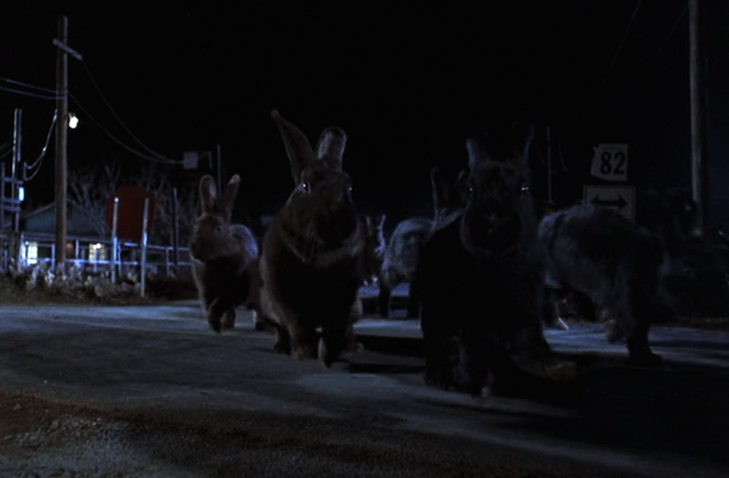
NIGHT OF THE LEPUS


d. William F. Claxton (1972)

Everybody knows that rabbits aren't scary or threatening, no matter how massive they are or how much ketchup you smear around their mouths and adorable twitching noses.This simple fact, seemingly ignored by all involved in this farcical production, completely destroys any scintilla of authenticity from the opening shot onwards. After 90 minutes, as we watch hundreds upon hundreds of giant rabbits shot to bits and electrocuted, we don't feel any relief that a scruffy piece of American desert and a few hillbillies have been saved, we just feel desperately sad for the slaughter and a little bit dirty, like Sir Stanley Baker at the end of Zulu.

The overgrown 'lepus' haven't been created by 'bad' science in this instance - their rapid growth, rampant aggression and unexpected liking for human meat is actually the result of humane, experimental work to inhibit their breeding and save them from a total cull. Put that in your irony pipe and puff it, PETA. The test tube work is done by an idealistic 'young couple' Stuart Whitman and Janet Leigh (both in their mid forties but looking much older) but is inadvertently compromised by their young daughter, who can't resist playing with the fluffy specimens and accidentally mixes up the test subjects - with preposterous results.  

This small but pivotal role was originally earmarked for the teenage Jamie Lee Curtis, until Mum Janet vetoed it: she didn't want her little girl anywhere near a horror film.

Anyway, if you do have a rabbit, go and stroke it. Other pets / euphemisms may very well apply.  

Friday, 11 September 2020

BLOOD FREAK


d. Brad F. Grinter (1972)

We've all seen cautionary tales about the dangers of drug consumption, and those of us who like our films psychotronic will have seen our fair share of movies about the transformative powers of mad and unsanctioned science. Blood Freak manages to combine these two hot topics to present us with the far out story of a narcotics fiend who turns into a turkey.

Hunky Herschell is just back from Vietnam, with only a badly burned arm and a dope habit to show for his tour of duty. While riding from town to town on his chopper, he meets up with Angel, a Bible spouting dolly bird who, despite her obvious moral rectitude, takes him to a hippy drug party and introduces him to her wilder and more switched on sister, Ann. Sultry Ann sets her cap at the upright, uptight Herschell, and conspires with her sleazy drug dealer to get her target to smoke an instantly addictive joint, after which he falls into bed with her.

Herschell gets a job at the local poultry farm where, for extra cash, he chows down on turkey that has been illegally experimented upon. Soon afterwards he has a seizure and, when he wakes up, he is surprised to find (as are we) that he has the big, gnarled head of a turkey cock and major collywobbles from drug comedown. Actual turkey, cold turkey: it’s a very clever metaphor. Doubly damned, he now creeps about grabbing addicts and slitting their throats, drinking their dope rich blood like coca cola while his supposedly dead victims cough and splutter as the strawberry syrup goes into their eyes and up their noses. 

This madness is interspersed with sardonic commentary from director, Brad F. Grinter, a permanently smoking grizzled guy who has clearly lived hard and well and reads his erudite words from an offscreen piece of paper, perhaps due to short term memory loss. Grinter concludes this outrageous story by saying that it is 'partly based on fact, partly based on probability', clearly bullshit. In the end analysis, though, this is a film about a vampire turkey that manages to entertain without a knowing nod, a wink or an arched eyebrow, so it's pretty much beyond normal criticism as far as I'm concerned. 

Friday, 7 February 2020

THE TWILIGHT PEOPLE


d. Eddie Romero (1972)

Edgar ‘Eddie’ Romero was a legend of the Filipino film industry. Working from the late 1940s up until 2008 (he died in 2013, aged 88), Eddie produced, wrote and directed dozens of films and TV shows, eventually attaining a respectability and artistry that few non-auteurs achieve. For the narrow purposes of this weblog, we’ll concentrate on the hugely entertaining English language exploitation films he made in the 1970s, specifically his shoestring take on The Island of Doctor MoreauThe Twilight People.

The film stars John Ashley, a recurring presence in Romero films of the period. Ashley had been a minor teen idol and even more minor pop star, playing eternal youths in AIP horror and beach films well into his thirties. He happily relocated to Manila when US roles dried up, eventually working behind the scenes of Apocalypse Now for an extended period: he was the guy who arranged to borrow the helicopters. Here he plays Matt Farrell, a slightly pudgy playboy and renaissance man who is kidnapped by a mad scientist who wants to splice his superior genes with wildlife, thereby creating a super race of human-animal hybrids that he believes will form the next stage of evolution. 

It’s not working too well so far, as all he’s managed to do is to create a menagerie of unhappy freaks: apart from his mad, mutated wife, he has a man bat (disturbing), a goat man (perplexing), a monkey boy (randy and annoying) and a young woman who has a very furry face who I eventually realised was supposed to be part dog. Oh, and he also has a constantly miaowing Panther Woman, played by the magnificent Pam Grier (underused). It’s all a bit disorganised and deeply unethical, and Farrell is the sort of straight up guy who inspires confidence, so he very quickly turns the mad scientists daughter against her Father and breaks out the hybrids, who make their way into the jungle in search of freedom, closely pursued by the scientists hired thugs, led by a peroxided sadist who only drinks milk. 

As you might expect, the film is no masterpiece but it is surprisingly well written, well directed and mainly well-acted, as well as being shot in a number of interesting locations. For all its quiet competence, however, it is sometimes marred by abrupt edits, as if material has been removed or added at the last minute, leading to jarring and sometimes noisy transitions. The monster make up is okay (lots of stick on fuzz and silly teeth), and the special effects, including spurting blood and some animation, are about right. In the end analysis, it’s a cheaply made but ambitious film about strange and fantastic things, kept from tipping into silliness by a matter of fact and professional approach - which sounds slightly dull but actually never is.

Friday, 1 November 2019

ENTER THE DEVIL


d. Frank Q. Dobbs (1972)

Slightly sluggish but intermittently interesting movie set in the Texas desert close to the border with Mexico. A laid back deputy with a little blond moustache and a taste for the Senoritas investigates the growing number of tourists, rock collectors and spelunkers who have gone missing in the area, little suspecting that they are the victims of a bloodthirsty satanic group who dispatch their sacrifices in a number of unpleasant ways: by sword, by rattlesnake, by barbed wire, by fire, oh, and by crucifixion, always by crucifixion.

There's something terribly cinematic / dramatic about a cave at night filled with a hooded, robed coven, especially when they are carrying flaming torches and chanting ominously in Latin, which is just as well, as these scenes are shown more than once and go on for ages. 

A sudden and surprising death ups the ante for a bit, but it shifts into a lower gear until a fairly predictable revelation and a bloody massacre conclude events. The last word belongs to the County Sheriff, who says he is going to seal up the devil's cave once and for all: 'maybe dynamite will put an end to all this foolishness', he drawls. Foolishness? A game of Knock Down Ginger is foolishness, the deaths of twenty people in the name of Satan is a different thing entirely.

Friday, 13 September 2019

CHILDREN SHOULDN'T PLAY WITH DEAD THINGS


d. Bob Clark, 1972

Bob Clark directed a number of films that would fit perfectly here, not least the disturbing and hallucinatory Death Dream, and one of the best ever Sherlock Holmes films, Murder By Decree. At the end of the decade, he blotted his copybook by kick-starting the teen sex comedy genre with the execrable Porky’s but, hey, nobody is perfect, least of all you. 

Children Shouldn’t Play With Dead Things was Clark’s full directorial debut (he only co-directed She-Man: A Study of Fixation) and has a more than a whiff of a student production about it: it’s talky, quirky and democratic - everybody gets a monologue or a bit of business. Appropriately, his cast were drawn from his college friends, and the characters they play share their own real first names. They all give good performances with one exception, but as the actress in question was married to the director at the time he probably didn’t feel comfortable to ask her to stop rolling her eyes. 

The Children of the title are actually a troupe of hippy-ish actors, all aged somewhere between 18 and 35. They are led by Alan, an awful little popinjay of a man-child who, by virtue of paying their wages, belittles and humiliates his colleagues at every turn, presumably to make himself feel better about his own unlovely inconsequence. Alan adores the sound of his own voice, and uses litanies of big words as alliteratively as he can. He also likes a joke, as long as it’s at someone else’s expense: the worse his victims feel, the louder and longer he laughs. His latest put on is for the group to travel to an old cemetery on a small island with a Grimoire full of incantations that he claims will reanimate the dead. In pursuit of this, they lightheartedly desecrate graves, rob corpses and wage warfare with each other through passive aggressive wisecracks. 

Given their youth and groovy wardrobe, it’s all a bit like a bitterly amusing episode of Scooby Doo guest starring The Manson Family, something that I really do wish existed. When the dark spell unexpectedly works, however, and long dead mouldering corpses start to punch their way out of the dirt (hungry, of course, for fresh human flesh) it leads to a chaotic, bloody, atmospheric finale that sucks all of the comedy out of this comedy horror and leaves us with a sense of dread, especially when we see the shambling, insatiable corpses happily hopping onto the troupe’s boat and setting off for the mainland... 

The moral of the story: never, ever join an acting group. 

Just time to mention my favourite part of the film, its score. Played by Carl Zittrer on, I'm assuming, a car sized synthesiser, the music comes in big, fat slabs of atonal electronic noise, sounding at even its most melodic like someone hitting the keys of an organ with a mallet. It makes no attempt to do anything other than just creep us out and, as such, is excellent.    

Friday, 5 July 2019

A THIEF IN THE NIGHT


d. Donald W. Thompson (1972)

There's no time to change your mind / 
                        The Son has come and you've been left behind...

I’m not a religious person (far too cynical), but I am fascinated by the odd and occasionally disturbing things people of faith so fervently believe in. A classic example  is The Rapture, which is the subject of A Thief In The Night, the first of four Evangelical films made in the 70s and 80s that examine this phenomena in unprecedented detail.

As you may know (and if you read this), The Rapture is the moment when true believers (dead and living) will be raised into the heavens to join Jesus Christ. This is usually interpreted as an instantaneous event, i.e. one moment they will be there, the next they will be gone, forever. In typical style, true believers are those are only those who have accepted Jesus Christ as their personal saviour, and nobody else, no matter how much they believe in God or how nice they are will be accepted. It's the Christian church,  the selection criteria is not kindness, but compliance. This miracle will, of course, cause widespread social unrest, and will lead to the formation of a fascistic world government who will brand the remaining population with 666. Jesus will then come back to save the day, but it will mean the end of the world. There, now you know as much as I do.

This film, which is carefully and professionally presented, has lots of great moments: a fairground conversion to religion; a cobra snake attack; the realisation that loved ones have vanished; sinister broadcasts from the head of the emergency world government, The Imperium; a look at the stuffy bureaucracy of fascism; a helicopter chase, and a dream within a dream framework that almost manages to avoid cliché. Astonishingly, it is claimed that this film has been seen by 300 million people across the world – and it’s really, really weird. Result!

My favourite part of the film is its opening, in which an amateur band of teenagers sing Larry Norman’s song about The Rapture, I Wish We’d All Been Ready (later covered by Cliff Richard). It’s very earnest and intense, occasionally off key and sets the scene perfectly for the madness to come.